# EN_20: Theoretical Basis of Einstein VED
# Authorship and Contact
Víctor Estrada Díaz
Independent Researcher | Foundations of Physics
Academic email: quark-cha@estradad.es
ORCID: 0000-0001-9942-1021 Personal website: https://estradad.es/teorias
©Víctor Estrada Díaz – 2023 This work is licensed under a Creative Commons
Attribution 4.0 International License (CC BY-NC-SA 4.0).
# Reconciliation of Quantum Mechanics with Einstein's Relativity
"This work starts from the conviction that Einstein was right to question the probabilistic interpretation of quantum mechanics as a fundamental property of nature. By demonstrating that quantum phenomena can be described through relativistic and non-hidden variables ( $\lambda$ ) —where probability is no longer a physical entity, but a measure of epistemic ignorance—, the contradictions with special relativity are eliminated.
If adopted, this framework would finally reconcile Einstein's relativistic world with the quantum domain, resolving paradoxes such as entanglement without action at a distance and the instantaneous collapse of the wave function. Gaia astrometric data supports this view, revealing dynamic anomalies that standard models cannot explain.
Beyond resolving theoretical debates, this proposal opens a new panorama for physics: a universe where causality, objectivity, and relativity are not sacrificed at the altar of quantum chance. The path is traced; it now corresponds to the scientific community to explore its implications."
**Figure 1: space-time**

**Description for blind people:**
This figure represents an original geometric deduction of space-time performed by the author from Lorentz equations, first published in the year 2000 and maintained until today (2025).
It is crucial because it defines space-time at the differential level in the four dimensions —three spatial and one temporal— and is applicable to any point in the universe. From the diagram it can be observed that two entangled particles located at opposite positions on a spherical wavefront share their proper time. From an external perspective, they appear separated by a great distance. However, in their own frame of reference, both share the same point of origin and the same temporal instant.
The mathematical relationship that expresses this is $dt' \to 0$ and $t = t_0 + 0$, which implies absolute simultaneity in their proper space-time. This figure is fundamental because it allows understanding space-time from a purely geometric perspective, without the need for conversion constants like the speed of light. By working with consistent units in all dimensions, it is established that $c = 1$, which eliminates the need to transform meters into seconds or vice versa.
In fact, measuring space time in compatible units is already done when we define the meter as the distance light travels in a vacuum during a fraction of a second. So, if we use the second as a temporal unit, why not use the "light-second" as a spatial unit? This coherence of units reveals that space and time are not independent, and that their entanglement gives rise to phenomena such as superposition, quantum entanglement, space-time uncertainty, and the reconciliation between Einstein's relativity and quantum mechanics.
The figure also allows observing the trigonometric relationship between the differentials: the hypotenuse is $dt$, the legs are $ds$ (space) and $dm$ or $dt'$ (proper time of the observed). On a wavefront where $c = 1$, it holds that $ds/dt = 1$, therefore $ds = dt$, which implies that all particles —even those situated at antipodal points— share the same instant: $t = t_0 + dm = t_0$. They share a proper space-time: $t_0, e_0$.
From this figure, multiple implications are deduced:
- The fusion of space and time as non-independent entities.
- The emergence of space-time uncertainty.
- The demonstration that superposition and entanglement are not a magical and mysterious property as quantum mechanics claims but a purely relativistic and geometric property of space-time.
- A path for reconciliation between Einstein's relativity and quantum mechanics.
- The understanding of extreme states as complementary dualities: space-time, matter-energy, observer-observed.
- And an even more ambitious implication which is to establish that everything observed in the universe arises from the properties of time, affirming that space itself arises from the differential separation of the flow of two distinct points in space.
The reader can observe the trigonometric relationship between the differentials: the hypotenuse is $dt$, the legs are $ds$ (space) and $dm$ or $dt'$ (proper time of the observed). On a wavefront where $c = 1$, it holds that $ds/dt = 1$, therefore $ds = dt$, which implies that all particles —even those situated at antipodal points— share the same instant: $t = t_0 + dm = t_0$. They share a proper space-time: $t_0, e_0$.
## A universal non-negotiable principle: No privileged observer
We establish as a starting point the following principle, compatible with special relativity:
**No privileged observer exists.** All physical laws must apply universally and indifferently to any observer, regardless of their state of knowledge, their position or their frame of reference.
We accept as given the laws of Lorentz and Einstein's postulates. This principle implies that no observer can alter the physical reality of a system simply by observing it, knowing it or ignoring it.
However, in traditional quantum mechanics, an active role in determining the physical state of the system is attributed to the observer. This treatment, exemplified in the so-called "collapse of the wave function", contradicts the fundamental symmetry principle of physical laws: their validity must be independent of the observer.
## Thought experiment: the two automated spacecraft
Suppose two spacecraft, A and B, identical in all aspects. They remain at relative rest in deep space, separated by a constant distance and without appreciable gravitational influence from the environment. The spacecraft are designed to operate completely **automated**, without conscious human intervention.
Both carry autonomous measurement and analysis systems, which will act according to an identical, pre-agreed and synchronized program.
The environment is considered closed: the spacecraft receive no external signals, emit no information during the experiment, and the systems are designed not to share data between them until the experiment has concluded. A and B cannot observe the exterior nor communicate with each other while in motion.
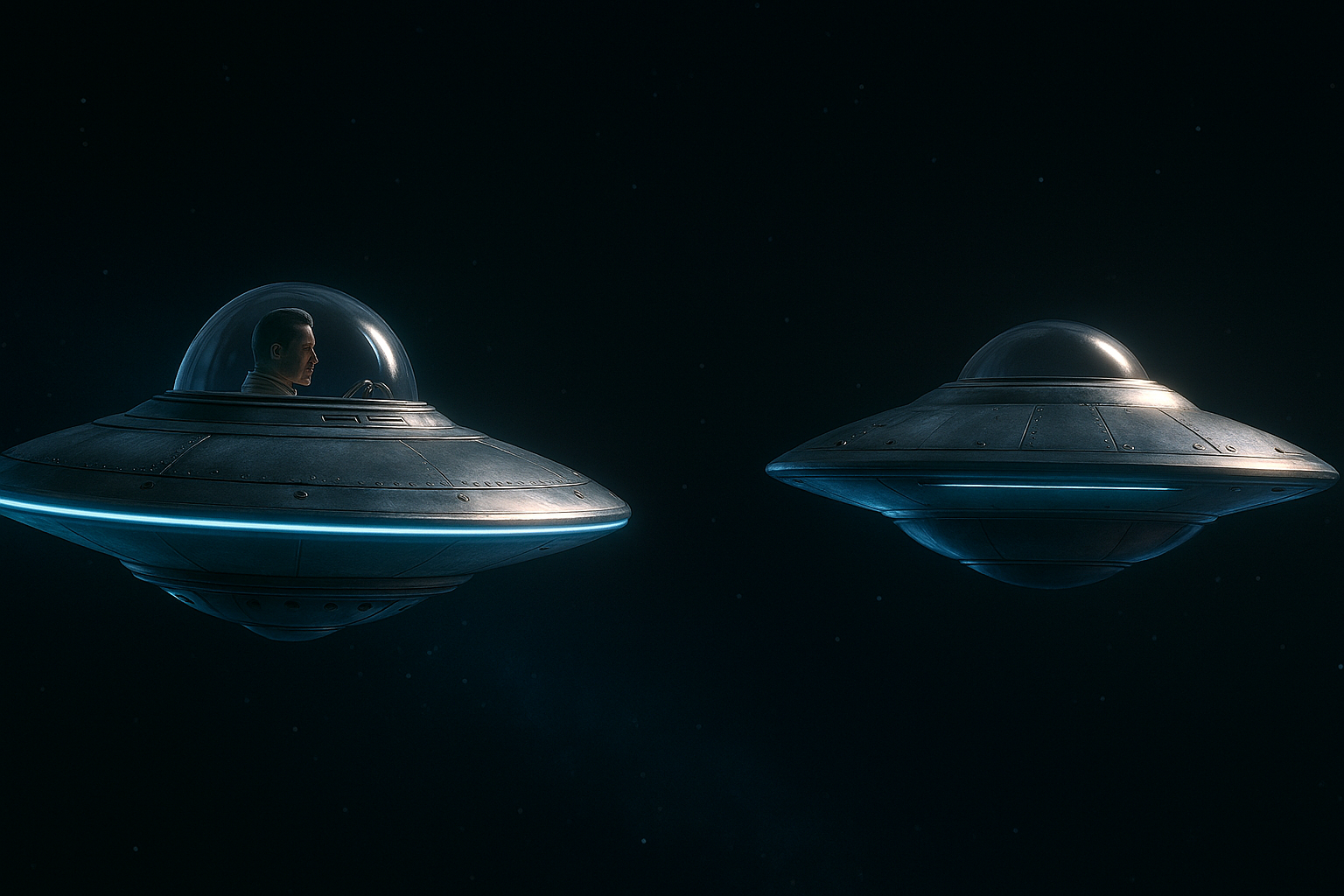
**Extended description for blind people:**
The image shows two alien spacecraft with saucer shapes suspended in deep space. The spacecraft on the left has a transparent dome where a human pilot is clearly visible, with a concentrated expression. The spacecraft on the right is similar but slightly different, with no visible pilot. Both are facing each other, floating in perfect symmetry, without stars, planets or background to indicate which will move. The scene represents a relativistic dilemma: without external references, it cannot be determined which of the two will initiate the journey or who is moving away from whom. The ambiguity is total, and causality is suspended.
### Initial situation
From the midpoint between both spacecraft, a pair of entangled particles (e.g., photons with opposite polarization) is emitted, traveling in opposite directions: one towards A and the other towards B.
The automated devices of both spacecraft are programmed to perform a specific measurement on the received particle —for example, measuring its polarization relative to a determined axis— and store the result locally.
### Figure 2: Relativistic symmetry between two spacecraft
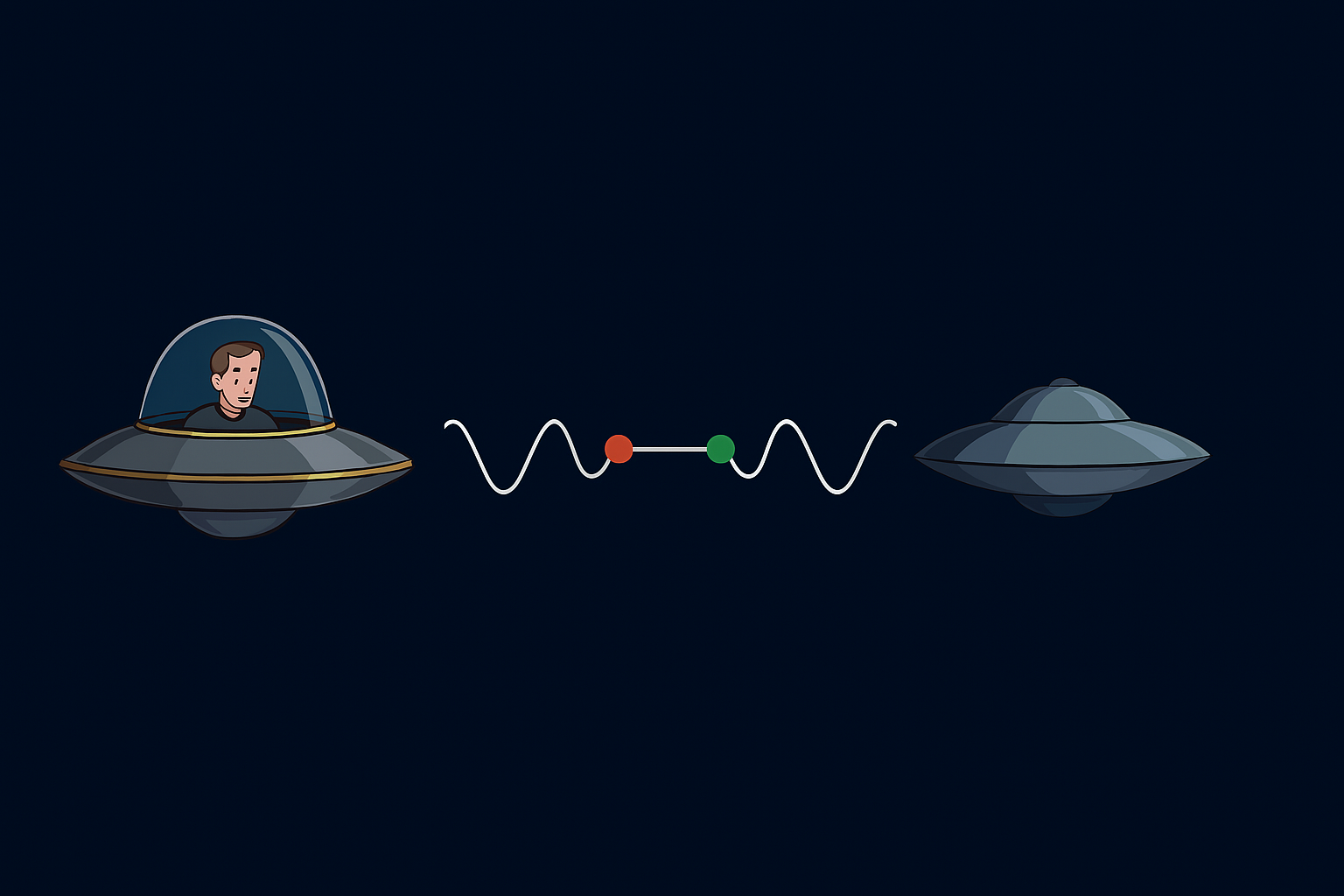
**Description for blind people:**
The image shows two alien spacecraft facing each other in the absolute vacuum of space. The spacecraft on the left has a transparent dome with a human pilot visible; the spacecraft on the right is similar but with no visible pilot. From the midpoint between them, a pair of entangled particles —represented by wavy lines heading towards each spacecraft— is emitted, as if they were photons with opposite polarization.
The background is dark and starless, reinforcing the absence of external references. This configuration represents a relativistic situation where it cannot be determined which of the two spacecraft will initiate the movement. The symmetry is total, and causality is suspended. The scene illustrates how, in the absence of an absolute frame, motion is relative and perception depends on the observer.
### The dilemma
Quantum mechanics predicts that:
- Each local measurement gives an apparently random result.
- But when comparing the results after the experiment, a perfect correlation between A and B is verified.
The act of measuring, according to the Copenhagen interpretation, causes the wave function to collapse. That is, the particle in A instantaneously acquires a defined property, and therefore, also the particle in B.
But here the contradiction arises: no observer is present, nor is there a conscious act of observation. The spacecraft are isolated, without the ability to interact.
Then:
- What causes the collapse?
- When does it occur?
- To which observer should it be attributed?
### The conflict with the universal principle
Recall our non-negotiable principle:
**No privileged observer exists. All physical laws must apply equally to any observer, anywhere, under any condition.**
If A measures before B, and the universe "collapses" the state of the particle in B at that instant, then the system has assigned a privilege to A's frame. That contradicts special relativity and our universal principle.
Conversely, if both measurements are independent and random, how is the perfect subsequent correlation explained without violating local causality?
And if the correlation occurs without causal mediation between A and B, we are accepting an instantaneous action at a distance, which Einstein already denounced as "spooky action".
### Partial conclusion
This experiment shows that:
The concept of probability used in quantum mechanics does not describe a physical property of the system, but a degree of ignorance of the observer. When the observer is eliminated, the paradox persists, revealing that the current formalism superimposes epistemology with ontology, thus constructing a universe where ignorance generates real physical events.
### The principle of no privilege and the relativity of motion
In our thought experiment we have introduced two observers: A and B, located in spatially separated spacecraft with no initial relative motion. At some point, one of the spacecraft initiates uniform rectilinear displacement relative to the other.
At this point, one might think —for descriptive convenience— that A remains at rest and that B moves away. However, this statement is physically and conceptually incorrect.
*No absolute reference system exists. Modern physics, from Galileo to Einstein, has firmly established that only **relative motion** makes sense.*
From A's point of view, it is B who moves. From B's point of view, it is A who moves away. No observer can be privileged without violating the fundamental principles of relativity.
This observation is of supreme importance, as it forces us to ask:
- If quantum collapse occurs when an observer measures, who measures first, if there is no universal time nor privileged reference system?
- How is the "collapse" coordinated between A and B if both can claim to have been the first to perform their measurement, depending on the frame used?
- Does the universe have a hidden hierarchy of observers, contrary to what relativistic physics postulates?
The mere fact that the quantum formalism allows (and in some cases requires) such contradictions shows that the problem is not physical, but epistemological.
Quantum mechanics inconsistently mixes the observer's knowledge with the physical evolution of the system, creating paradoxes that cannot be resolved without violating some fundamental principle.
As we will see later, this structural ambiguity cannot be saved with more sophisticated interpretations or formal adjustments. A foundational revision is necessary, clearly distinguishing between:
- What the system is (ontology), and
- What the observer knows or ignores (epistemology).
### Reunion: observer B returns
After a period of separation, observer B —located in an automated spacecraft and initially in relative motion with respect to A— returns to the point of origin. This return can be seen as a symmetric trajectory, in which B accelerates, reverses, and coincides again with A.
At this point, A and B are again in direct contact and can compare their measurements, proper times, and observed (or unobserved) quantum states.
Here we introduce the key to the conflict between relativity and quantum mechanics:
**What happened to the shared quantum system while A and B were separated?**
In the standard interpretation of quantum mechanics:
- A system can be in a superposition of states until someone observes it.
- Measurement causes a collapse of the wave function, defining a concrete value.
- However, if A and B are separated and there is no communication, each can have a different description of the system's state.
This raises disturbing questions:
- Who really collapsed the wave function, if both were isolated?
- Did the collapse occur from A's point of view but not from B's?
- Or did the wave function "wait" until both met again?
Any of these answers leads to serious contradictions:
- If the wave function collapses in one frame but not in another, the relativity of motion is violated.
- If it collapses "objectively" at some universal point, a hidden privileged frame is introduced, against the relativistic principle.
- If the collapse depends on the observer's knowledge, we are using an epistemological concept as if it had ontological entity, which is philosophically unacceptable and physically inconsistent.
### Reunion and quantum-relativistic conflict
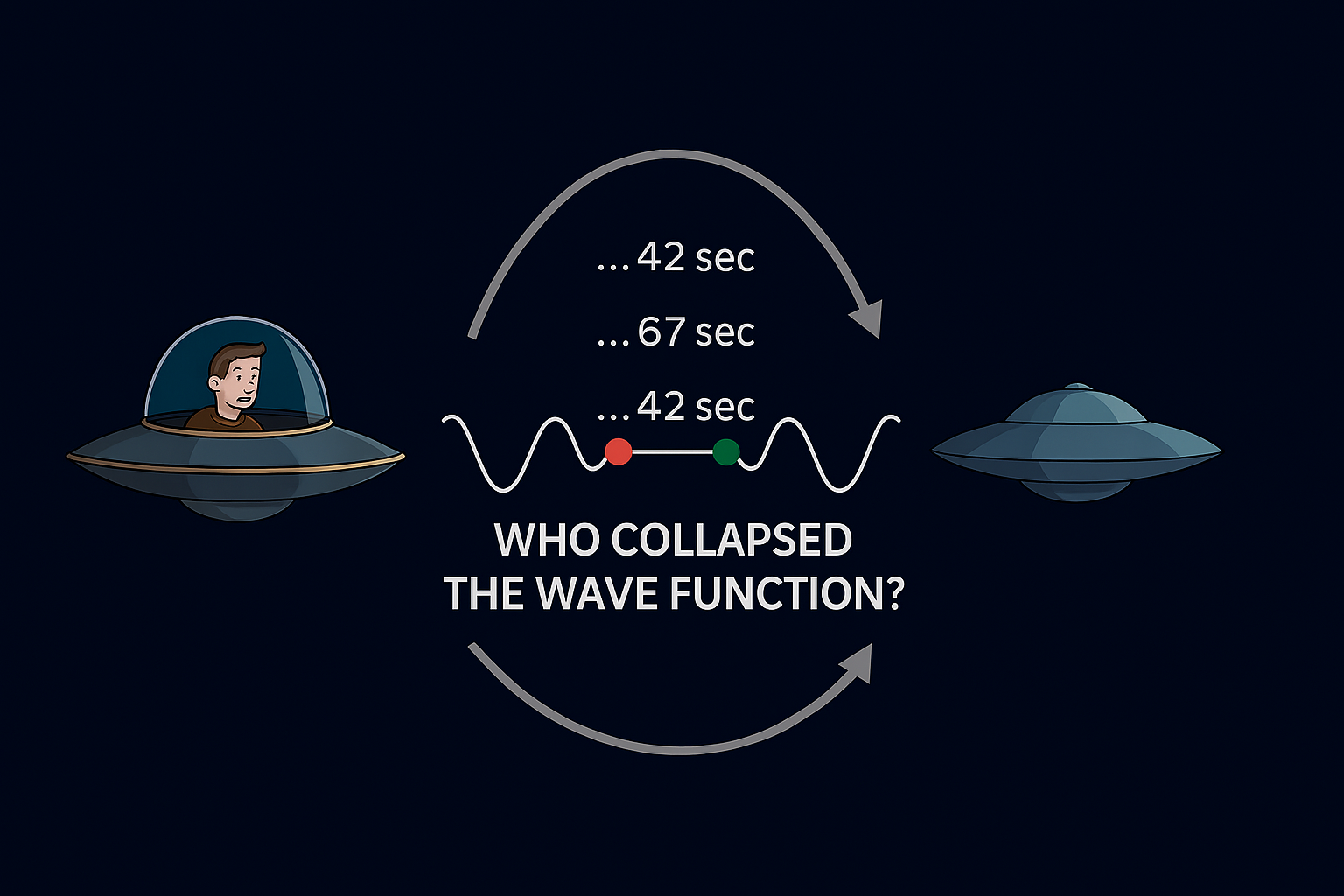
**Description for blind people:**
The image shows two alien spacecraft facing each other in the vacuum of space. Spacecraft A, on the left, has a transparent dome with a visible human pilot. Spacecraft B, on the right, is similar but with no visible pilot. A parabolic arrow connects both spacecraft, representing the round trip of observer B. On the arrow there are time marks indicating different phases of the journey.
In the center of the image, between the two spacecraft, a shared quantum system appears represented by two entangled waves —one red and one green— that originate from a common point and head towards each spacecraft. Below the waves, in white letters, the question is posed: **"WHO COLLAPSED THE WAVE FUNCTION?"**
The image illustrates the fundamental dilemma between relativity and quantum mechanics: during the separation between A and B, when and from which frame was the wave function of the quantum system collapsed? Or did it not collapse until the reunion? The scene conveys the ambiguity of quantum collapse in the absence of an absolute reference.
### Conclusion of the thought experiment
The thought experiment of the two automated spacecraft highlights that the probabilistic interpretation of quantum mechanics inevitably leads to irresolvable conflicts with special relativity.
Specifically:
1. It introduces a privileged observer (the one who measures first), contradicting relativity.
2. It makes the physical reality of a system depend on the information available to an observer, confusing epistemology with ontology.
3. It implies instantaneous action at a distance to explain correlations, violating relativistic causality.
Therefore, we conclude that:
**Probability in quantum mechanics cannot be interpreted as a fundamental property of nature.**
It must be understood, instead, as a reflection of our ignorance about the hidden variables that govern the real evolution of the system.
### Reformulation: the geometric structure of the quantum system
Faced with the contradictions that arise when trying to reconcile quantum mechanics with relativity —especially in contexts like that of the two facing spacecraft— we propose a radical reformulation: there are no hidden variables, no wave function collapse, no privileged frames. What exists is a geometric structure of space-time that causally determines the evolution of each system from the observer's point of view.
### The event as causal bifurcation
Each event in space-time, experienced from the observer's proper time $t = t_0$, represents a causal bifurcation. At that instant:
- The past is defined and conditions the present.
- The future is geometrically open, not yet defined.
- The observer's choice at that point determines their future space-time line.
- That choice is irreversible: there is no turning back, because each decision experienced defines the observer's universe.
### There are no hidden variables
The idea of "hidden variables" is conceptually wrong in this framework:
- There is no hidden information nor unobservable states.
- What exists is a complete causal structure towards the past, and a structural indefinition towards the future.
- Ignorance of the future is not an epistemological limitation, but an ontological condition that allows choice.
### The wave function does not collapse
The so-called "collapse of the wave function" is a misinterpretation:
- There is no magical discontinuity in the system's evolution.
- What is interpreted as collapse is simply the causal updating of the system from the observer's frame.
- Each observer lives their reality from their point in space-time, and does not need to postulate collapses or non-local actions.
### The choice of role: observer or observed
In symmetric situations like that of the two spacecraft:
- We can choose to be A or B, observer or observed.
- The laws are imputable and complete for both.
- But the choice defines our space-time line:
- The observer will be the old one, the one who has lived and conditioned the future.
- The observed will be the young one, still in geometric openness.
- This choice is ontologically incompatible simultaneously, but both options are possible and real.
- Once chosen, it cannot be reversed: the observer's universe is defined by their trajectory.
### Comparison with "many worlds"
Superficially, this framework may seem similar to the many-worlds interpretation. However:
- The simultaneous existence of multiple universes is not postulated.
- Only one exists: the one the observer defines with their choice at each event.
- The diversity of futures is a geometric openness, not an ontological proliferation.
### The function $f$: causal delimiter
Later the function $f$ will be introduced, which delimits:
- Which part of the system is determined from the observer's frame.
- Which part remains open towards the future.
- How the causal structure is projected from each experienced event.
This function will be the formal tool that allows expressing mathematically the evolution of the system without the need for collapses or hidden variables.
### Universal property of the function $f$
This property —and the function $f$ that expresses it— is proper to every event within space-time. It marks the functioning of the universe for any instant $t = t_0$. The function $f$ is an intrinsic and internal property of space-time: it is not external, not added, not postulated. It is the geometric manifestation of causality at each point in the universe.
## Ontological implications of the geometric reformulation
Adopting this approach has profound consequences for the understanding of physics and the nature of the universe:
- **Probability is not a physical property**
Probability does not describe reality, but our relationship with it when we do not yet know it. It is a valid tool to bound ignorance, but has no ontological entity.
Once reality manifests in a concrete event, probability ceases to make sense: one cannot speak of the "probable" when what is is already known.
Quantum mechanics, when facing this dilemma, introduces the concept of "collapse of the wave function" as a transition between the probable and the defined.
In this framework, there is no need for collapse: the experienced event defines reality, and probability disappears as a tool.
- **The wave function does not collapse**
What is interpreted as collapse is a causal updating from the observer's point of view. There is no physical discontinuity nor ontological leap.
The evolution of the system is continuous, determined by the geometric structure of space-time.
- **Relativistic causality is preserved without paradoxes**
Quantum correlations do not require action at a distance nor absolute simultaneity. They arise from the shared geometry of space-time between the involved systems, without violating relativity or introducing hidden frames.
- **The observer is central, not irrelevant**
Each observer defines their universe from their proper time $t = t_0$.
Their choice at each event determines their future causal line.
Physics does not describe what is "known", but what is lived from their geometric frame.
## Astrophysical evidence: geometric reinterpretation from Gaia
Beyond the conceptual terrain, this framework finds resonance in recent empirical observations.
Data from the Gaia space mission, which has measured with unprecedented precision the position and motion of billions of stars, has revealed dynamic anomalies that challenge classical and standard relativistic gravitational models.
These anomalies do not require postulating invisible entities like dark matter, nor modifying Newton's or Einstein's laws.
What they reveal is that all those models omit an essential variable: the propagation time of the gravitational interaction.
At galactic scales:
- The gravitational force does not act instantaneously.
- Its effect propagates with delay, conditioned by the geometry of space-time.
- The stellar trajectories observed today respond to mass distributions that existed thousands or hundreds of thousands of years ago, not to current ones.
- Ignoring this temporal structure leads to erroneous interpretations that are attempted to be compensated with ad hoc hypotheses like dark matter or MOND.
These observations, far from requiring new substances, invite a rethinking of the real geometry of space-time.
The function $f$, introduced in this work, can offer a formal tool to model that causal propagation in real time, without the need for collapses, hidden variables or fictitious entities.
## General conclusion
This work argues that:
- Quantum mechanics, in its standard interpretation, is incompatible with Einstein's relativity because it grants the observer a privileged role and mixes epistemology with ontology.
- Quantum paradoxes (collapse, entanglement, action at a distance) dissolve when it is recognized that probability is not a physical property, but a valid tool while ignorance exists.
- The key is not to postulate hidden variables, but to understand that each event in space-time causally defines its future from the observer's frame.
- This approach is coherent with relativity, preserves local causality, and allows reinterpreting astrophysical phenomena without resorting to hypothetical entities.
- In particular, models like dark matter, MOND or $\Lambda$CDM are revealed as conceptually wrong: they do not contemplate the propagation time of the gravitational force, which at galactic scales can be thousands or hundreds of thousands of years.
- Stellar trajectories do not respond instantaneously to a static mass distribution.
- The observed dynamics is the result of a retarded interaction, projected from the causal past.
- Ignoring this temporal structure invalidates the interpretation of observational data, because an immediate response is assumed that does not exist in physical reality.
- As a consequence, fictitious entities —like dark matter— are introduced to compensate deviations that actually arise from an erroneous reading of geometric time.
This rethinking not only resolves quantum paradoxes, but opens the door to a more coherent physics, where causality, relativity, and the structure of space-time integrate without contradictions or artifices.
## Epilogue: the redefined universe
If this framework is confirmed, physics will not enter a new stage through reconciliation, but through reformulation.
It is not about reconciling relativity and quantum mechanics as separate domains, but about recognizing that both have been interpreted from incomplete premises.
- The universe is not a sum of probabilities and curvatures, but a causal geometric structure, where each experienced event defines the observer's future trajectory.
- Objectivity is not sacrificed to chance: chance disappears as an ontological entity when it is understood that probability is only a valid tool while ignorance exists.
- The observer is not a spectator nor a creator of reality: they are the point from which reality is projected, in their proper time, without privileges nor absolute simultaneity.
This framework does not reconcile: it redefines.
And in doing so, it opens the possibility of a physics where causality, relativity, and lived experience do not contradict each other, but mutually explain each other from a deeper geometry.
The path is not traced. It is being traced, event by event, by each observer who chooses.
**References**
1. Einstein, A., Podolsky, B., & Rosen, N. (1935). *Can quantum-mechanical description of physical reality be considered complete?* Physical Review, 47(10), 777.
2. Bell, J. S. (1964). *On the Einstein Podolsky Rosen paradox.* Physics Physique Физика, 1(3), 195–200.
3. Gaia Collaboration (2022). *Gaia Data Release 3.* Astronomy & Astrophysics.
[License](https://estradad.es/licencia.php) Víctor Estrada Díaz 2025
# VED Theory: Deterministic Explanation of Quantum Entanglement
**Author:** Víctor Estrada Díaz
**Date:** July 23, 2025
**License:** CC BY-NC-SA 4.0
## Introduction
The **VED Theory** I present proposes an explanation of quantum entanglement, derived from Einstein's relativity. This theory complements the Theory of Special Relativity. Supported by a geometric reinterpretation and the development of Lorentz transformations.
## Figure 1: Geometric representation of space-time

**Description for people with visual disabilities:**
Triangular diagram showing the relationship between temporal and spatial differentials. The hypotenuse (dt) represents the observer's time, the vertical leg (dm) the observed object's time, and the horizontal leg (ds) the spatial separation. The mathematical relationship is $dt^2 = ds^2 + dm^2$.
## Fundamental Postulate
Three differentials associated with space-time are defined:
- $dt$: flow of time in the observer
- $dm$: flow of time in the observed or mobile object ( $dm = dt'$ )
- $ds$: flow of spatial separation between observer and observed
Units are unified in seconds:
- Time in **time-seconds**
- Length in **length-seconds**
- With $C = 1$ ( $ds/dt = 1$ )
## Relation with Lorentz Equations
For one-dimensional motion (only X coordinate):
$$
dt^2 = ds^2 + dm^2
$$
where:
- $dm$ = proper time of the mobile (observed)
- $dm$ is used instead of $dt'$ to emphasize the geometric interpretation
## Quantum Entanglement and Relativity
The theory reconciles entanglement with Special Relativity:
- In a photonic wavefront, all particles share the same emission time $t_0$
- For a photon, the proper time between emission and detection is null:
$$
t = t_0 + dm \quad \text{where} \quad dm \to 0 \Rightarrow t = t_0
$$
- The **observer** measures detection at $t_1$
- The **photon** remains anchored at $t_0$, without evolution or collapse
**Conclusion:**
Entanglement and superposition are interpreted as a relativistic consequence: particles remain in their time of origin and the observer only accesses that state from their space-time frame.
## Geometric Foundation
### Differential notation
- $dt$: proper time of the observer
- $dm$: proper time of the mobile
- $ds$: relativistic invariant
- $dx, dy, dz$: spatial differentials
In light-second units:
$$
dt^2 = (dx^2 + dy^2 + dz^2) + dm^2
$$
For one-dimensional motion:
$$
dt^2 = ds^2 + dm^2
$$
**Key:** In relativistic trajectories, $dm \to 0$, keeping the particle bound to the emission instant.
### Time as the cause of motion
- Temporal differences generate motion
- Motion as a consequence of temporal inequalities
$$
ds^2 = dt^2 - dm^2
$$
### Unification of units
- Time in **seconds**
- Length in **length-seconds**
- $C = 1$ (no conversions needed)
### Geometric interpretation of Lorentz
Relativistic transformation:
$$
\frac{dt'}{dt} = \sqrt{1 - \frac{V^2}{c^2}}
$$
With $C = 1$:
$$
dt^2 = (dt')^2 + dx^2
$$
Interpretation:
- **Hypotenuse** = passage of time in the observer
- **Leg 1** = proper time in the mobile
- **Leg 2** = distance traveled
## Synthesis and Conclusions
Einstein-VED Theory:
- Provides a geometric and deterministic basis
- Explains space as differences in the temporal dimension
- Interprets quantum entanglement as conservation of the space-time origin of particles
- Respects the mathematical structure of Lorentz and Special Relativity
## Step-by-step deduction for particles at $c$
1. Particle travels at $V = ds/dt = 1$
2. Proper time differential:
$$
dm^2 = dt^2 - ds^2
$$
3. Since $ds = dt$:
$$
dm^2 = dt^2 - dt^2 = 0 \Rightarrow dm \to 0
$$
### Absolute proper time of the particle:
$$
t_{\text{proper}} = t_2 + dm = t_2
$$
### Conclusion (1): the **particle's time remains anchored**, simultaneous for all particles in the wavefront, while the observer measures normal intervals ( $dt \neq 0$ )
## Implications for relativistic entanglement
- Correlation between particles **does not require action at a distance or collapse**
- Arises from the **absolute simultaneity of proper time** in the wavefront
- All particles sharing the same proper space-time explains in a deterministic and geometric way why **the observer can measure correlations even between antipodal particles**
## Conclusion (2)
1. **Time and space are not independent**; their relationship is determined by the intrinsic geometry of space-time
2. **Differentials viewed from the observer** allow access to the mobile's proper space-time
3. Quantum entanglement is interpreted as a **manifestation of simultaneous proper time** in a wavefront
4. The theory provides a **deterministic and geometric explanation** of entanglement, fully respecting special relativity and the Lorentz metric
## Geometric representation of space-time
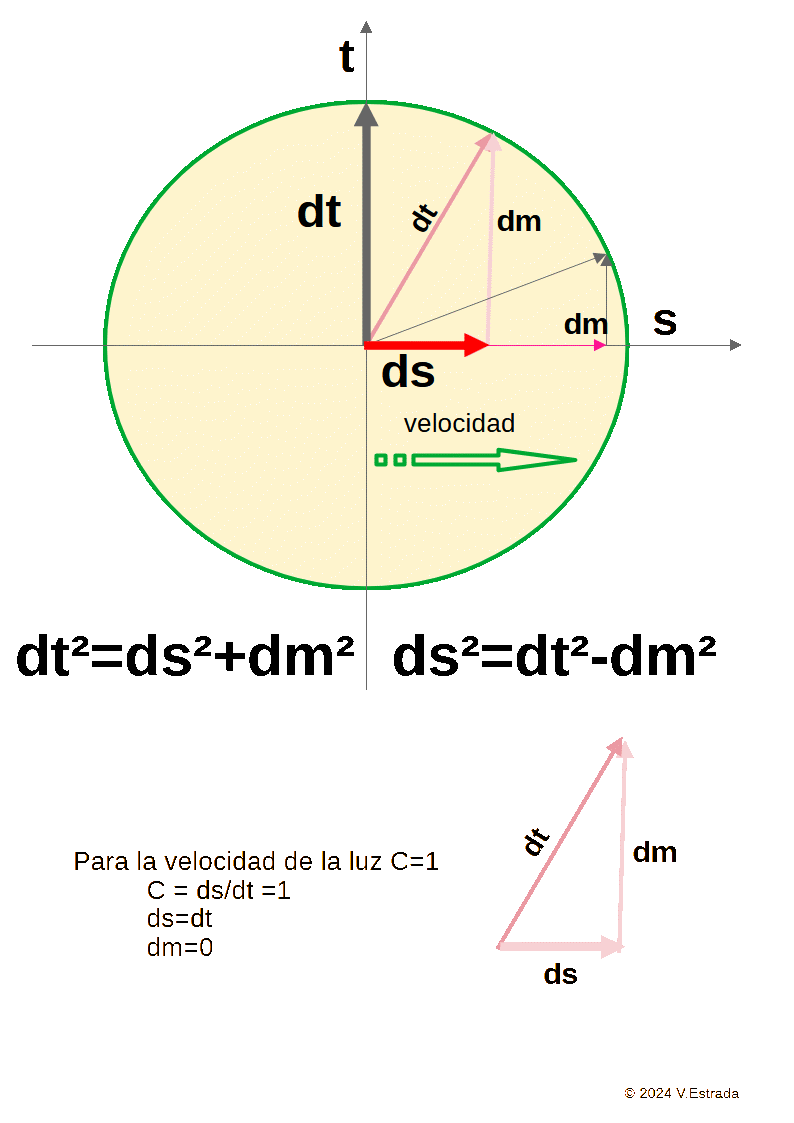
**Accessible description for blind people:**
This graph shows how the velocity of the observed system modifies the geometry of space-time from the observer's point of view. Two axes are represented: horizontal for space and vertical for time. At increasing speeds, the trajectory tilts toward the spatial axis, losing orthogonality with the temporal one. This tilt represents the interdependence between space and time.
## Independence of time and space
What is the dimensional explanation of independence?
- Two or more dimensions are independent when they are orthogonal.
When are space and time orthogonal?
- Only when $ds = 0$, that is when $V = ds/dt = 0$
- Space-time independence only exists when relative motion is zero.
The velocity $V = ds/dt$ implies that time and space are not independent. Whenever there is velocity, dimensional independence is broken.
## References
- Estrada Díaz, Víctor (2000). *The Dimensions of Space*.
[Available online](https://estradad.es/teorias/pdf/ES%20tiempo.pdf)
## Author and Links
- **Author:** Víctor Estrada Díaz
- **ORCID:** [0000-0001-9942-1021](https://orcid.org/0000-0001-9942-1021)
- **Zenodo:** [All works](https://zenodo.org/search?q=creators.orcid:%220000-0001-9942-1021%22)
- **Website:** [estradad.es/catalogo.html](https://estradad.es/catalogo.html)
- **License:** [estradad.es/licencia.php](https://estradad.es/licencia.php)
# COMPLETE ARGUMENTATION: EINSTEINIAN RECONCILIATION AND QUANTUM REFUTATION
**Author:** Víctor Estrada Díaz
## REFUTATION OF STANDARD QUANTUM MECHANICS
### Probability is ignorance, not physics
"Probability only makes sense when referring to incomplete knowledge. If the state of a system is known, there is no probability; there is certainty. QM treats superposition as physical reality, but this is a mistake: two observers (one informed, one ignorant) assign different probabilities to the same system. This demonstrates that probability describes the observer, not the system."
### The lottery ticket and probability as ignorance
"Imagine a friend mails you a lottery ticket in a sealed envelope, without having looked at the number. The draw has already occurred, but you haven't opened the envelope yet. Does it make sense to talk about probability? Yes, but not because the ticket is in multiple states, but because you are ignorant of its real state. The probability here does not describe the ticket, but your ignorance about it."
This example clarifies that probability is not a physical property of the system, but an epistemological tool of the observer. Quantum mechanics, by treating probability as if it were part of physical reality, confuses knowledge with ontology. Two observers —one informed, one ignorant— assign different probabilities to the same system, which demonstrates that probability describes the observer, not the universe.
In the Einstein-VED framework, this distinction is fundamental: quantum indeterminacy does not arise from physical chance, but from the geometry of shared space-time and limited causal access. The universe is not in multiple states: it is in a single one, and what varies is the observer's capacity to access it.
### Collapse is an unnecessary patch
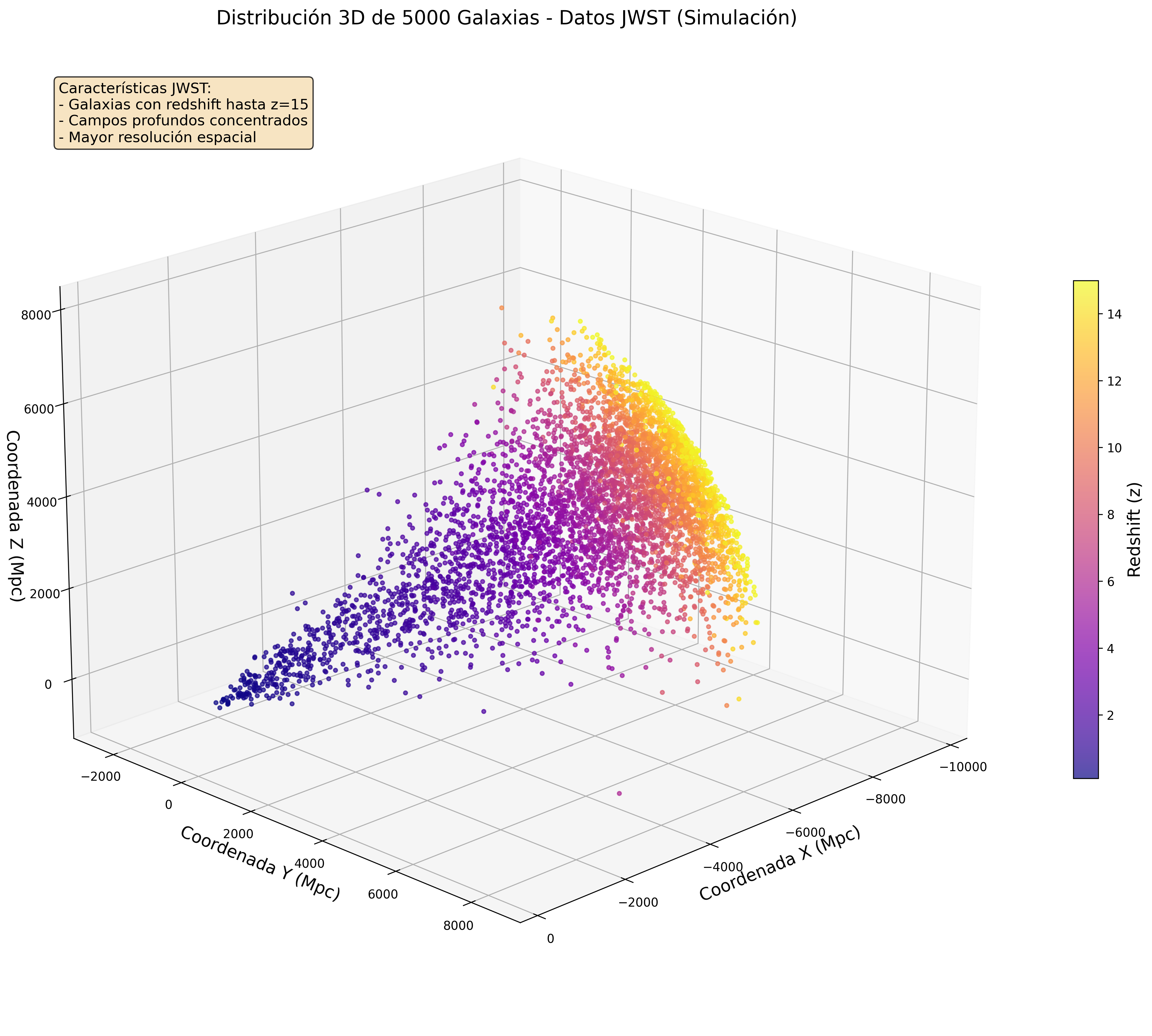
"The wavefunction collapse is introduced to restore a single reality after measurement. But this does not solve the problem: it relocates it. The real solution is that the state is not defined by the misnamed relativistic hidden variables ( $\lambda$ ), since such variables do not exist; it is the proper space-time of the particles, since they remain in the original causal event ( $E_0$ ). To measure is to reveal $\lambda$, not to collapse anything.
It simply is about having access to a proper time and space where the particles are, since their proper time does not flow from the origin ( $dt' \to 0$ when velocity $\to c$ ).
This makes the particles accessible even if they are antipodal to the wavefront."

### Entanglement without action at a distance
"Quantum correlations are not 'spooky action': they are consequences of a common causal origin. When two particles become entangled at $E_0$, their $\lambda$ states are already correlated. When measuring them with delays $\Delta t = \Delta x/c$, the correlations emerge without violating causality. Non-locality is an illusion of absolute simultaneity."
## 3D TIME THEORY AND FUNDAMENTAL GEOMETRY
### Time as the primordial field
"Space is a derived illusion: it arises from differences in temporal flows. The real metric is:
$$
ds^2 = dt_{\text{obs}}^2 - dv_{\text{rel}}^2
$$
where $dv_{\text{rel}}$ is the difference in temporal flow between points. Matter are vortices in the field $\boldsymbol{\tau} = (\tau_x, \tau_y, \tau_z)$, with mass $m \propto \oint \boldsymbol{\tau} \cdot d\mathbf{l}$."
### Gravity = Gradient of temporal flow
"Gravity is not the curvature of space-time, but a gradient in $\boldsymbol{\tau}$:
$$
\mathbf{g} = -\nabla \|\boldsymbol{\tau}\|
$$
This explains gravitational time dilation without the need for general relativity."
## DEATH OF DARK MATTER (GAIA DATA)
### Observational evidence
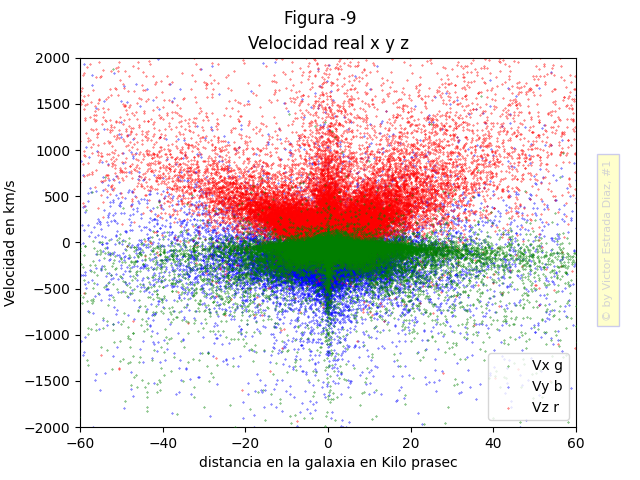
"Gaia DR3 data shows:
- **Orbital velocity $v \propto r^{0.5}$** (positive radial acceleration).
- **Velocity dispersion $\sigma_v \propto r$** (increasing chaos with distance).
This is incompatible with dark matter halos (which predict $v = \text{constant}$, $\sigma_v = \text{constant}$ ) and with MOND."
### The propagation of force and the collapse of standard cosmology
**Accessible description for blind people:**
Scatter plot representing stellar orbital velocities (in km/s) as a function of distance to the galactic center (in kpc), according to Gaia DR3 data. A clear north-south asymmetry and a positive radial acceleration are observed: velocities increase with distance, contrary to what classical models predict. The dispersion also grows with distance, showing a chaotic and non-stabilized structure. The plot contradicts the predictions of dark matter and MOND, and suggests that current cosmological foundations require revision.
Current theories on galactic dynamics predict that the orbital velocity of stars should decrease with distance from the galactic center, as happens in the solar system under Newton's law with relativistic corrections. However, real data —such as that obtained from Gaia DR3— shows the opposite: velocities increase with distance, and the dispersion also grows. This observation contradicts stability models and calls into question the validity of dark matter as an explanation.
Dark matter was introduced as an ad hoc term after the studies of Vera Rubin, who observed that velocities in galactic clusters did not match classical predictions. But this exotic particle has never been detected, and current data not only fails to confirm it, but openly contradicts it.
Motivated by this incoherence, I propose a deeper cause: **no current theory contemplates that the gravitational force has a propagation time**, limited by the speed of light $c$. This omission is critical. The **LIGO project has confirmed** that gravitational waves propagate at $c$, not instantaneously. If gravity takes time to propagate, then **stellar dynamics cannot be treated as a system of instantaneous interaction**.
This directly affects the calculation of orbits, velocities, and galactic stability. Ignoring the propagation time of the force undermines current models, including MOND and standard cosmology. If dark matter does not exist —as the data suggests— and the models ignore the propagation of the interaction, then **large-scale cosmology also fails**, including intergalactic structure, the interpretation of gravitational lenses, and cosmic expansion.
In the Einstein-VED framework, this correction is not an add-on, but a direct consequence of the **causal geometry of space-time**. The function $f$ delimits the influence of future events on the present, and the finite propagation of the interaction reinforces the need for a complete reformulation of cosmic dynamics.
### Explanation by gravitational delays
"Gravity propagates at $c$. At galactic scales ( $\Delta t = r/c \approx 300,000$ years for $r = 30$ kpc), this causes a disconnection between the central mass and the distant stars. Like a cosmic whip: the force arrives late, allowing the stars to accelerate freely."
### Ejection waves from black holes
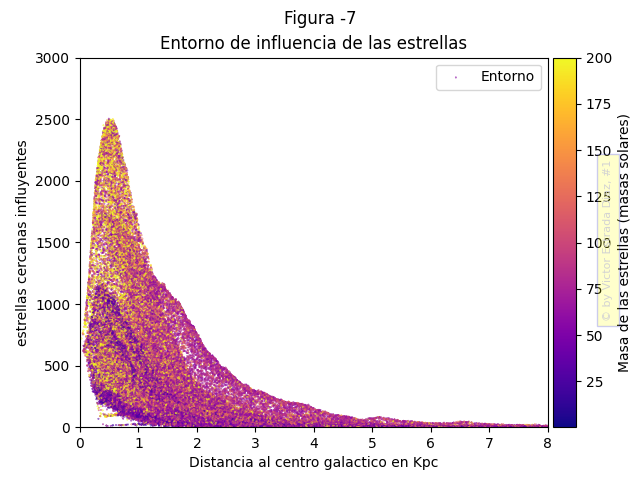
"Graph analysis reveals concentric waves of stars emanating from Sagittarius A* (spaced $\approx 3$ kpc). This indicates periodic matter ejections, refuting the Big Bang and primordial neutron nucleosynthesis."
## ONTOLOGY OF THE SPACE-TIME BLOCK
### Reality of the past
"All instants $t < t_0$ are as real as $t_0$. If not, $t_0$ would not exist. This implies that Turing in 1936 is *right now* writing 'On Computable Numbers' at his coordinates $(t_T, x_T)$. Death is an illusion of perspective: your loved ones live eternally in their time."
### Freedom and undefined future
"At $t_0$, the future ( $t > t_0$ ) is undefined. This is not a limitation, but a cosmic design:
- **Knowing the future** would make it immutable (determinism without freedom).
- **Ignoring it** allows free choice (turning left/right defines new real futures).
Thus, God gave us 'dice' (ignorance of the future) so that we may be free while the space-time block expands with our choices."
### Final reconciliation with Einstein
"'God does not play dice' (outside the block, everything is deterministic), 'but gave them to us' (inside the block, ignorance of the future) 'so that we may play' (we exercise creative freedom). QM is reconciled with Einstein when we understand that probability is the price of freedom in a geometrically determined universe."
## REFERENCES AND DATA
- **GitHub Repository:** [quark-cha/materia_oscura](https://github.com/quark-cha/materia_oscura)
- **Gaia Data:** [Radial Velocities](https://estradad.es/teorias/gaia_analisis/)
- **Documents:** [Complete Theories](https://estradad.es/teorias/)
## Author and Links
- **Author:** Víctor Estrada Díaz
- **ORCID:** [0000-0001-9942-1021](https://orcid.org/0000-0001-9942-1021)
- **Zenodo (all works via ORCID):** [All works on Zenodo](https://zenodo.org/search?q=creators.orcid:%220000-0001-9942-1021%22)
- **Website & Catalog:** [estradad.es/catalogo.html](https://estradad.es/catalogo.html)
- **License:** [estradad.es/licencia.php](https://estradad.es/licencia.php)