ARTICLE 03 — THE Qᵦ BIT AND THE Qᵥ BIT
Author: Víctor Estrada Díaz ORCID: 0000-0001-9942-1021 Project: ES_52 Series: Concepts of V-computing Status: Conceptual revision 1 Dual license — Ethics and use
Texts: CC BY-NC-SA 4.0. Sharing and adapting the texts is permitted with attribution to the author, without commercial use and with adaptations shared under the same license. https://creativecommons.org/licenses/by-nc-sa/4.0/
Code: HL3 — Hippocratic License 3.0. Commercial use of the code is permitted only if it complies with the ethical principles and the license conditions. https://firstdonoharm.dev/version/3/0/
Author’s ethical restrictions: uses for wars, human rights violations, environmental harm, exploitation, mass surveillance and discrimination are prohibited.
Author’s ethical principles: respect for human dignity, no profit-making use without permission and prohibition of harmful uses.
Reference for the dual license and the author’s conditions: https://estradad.es/licencia.php
This article defines the units Qᵦ and Qᵥ and establishes the conditions of their operational correspondence.
V-computing proposes building machines with conventional electronic or computational components capable of performing operations associated with qubits, without needing quantum formalism to determine their operation.
To develop this construction, we need to distinguish three concepts:
The physical state of a unit.
The observer’s knowledge of that state.
The result obtained when a measurement is performed.
This distinction allows a correspondence between Qᵦ and Qᵥ to be established without imposing on V the physical interpretations used to describe Q.
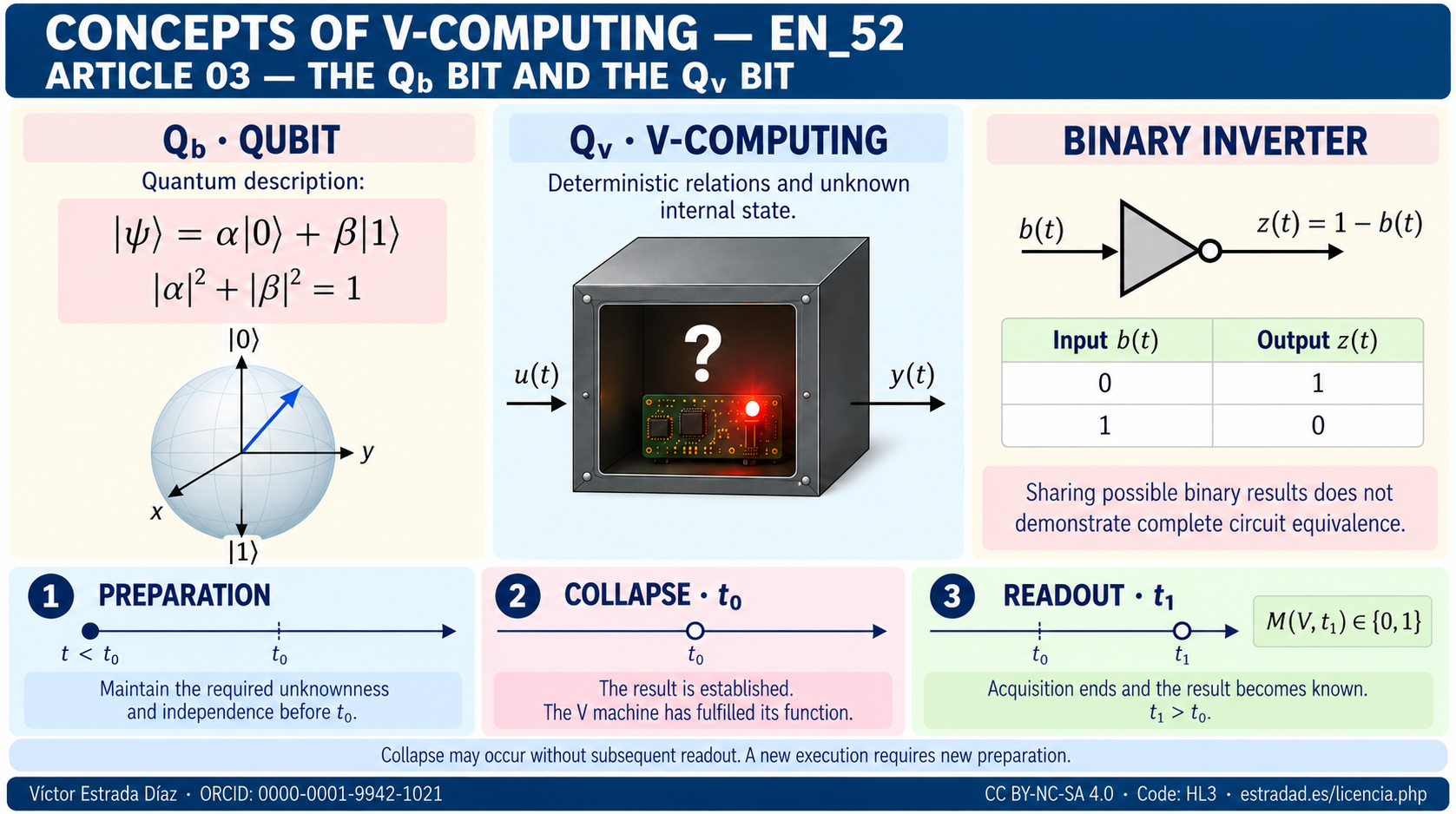
We will call a binary quantum unit, usually called a qubit, Qᵦ.
When measurement is performed in the computational basis, the operation provides one of the values:
M(Qᵦ,t₁) ∈ {0,1}
The usual quantum description uses a state vector:
|ψ⟩ = α|0⟩ + β|1⟩
With the normalization condition:
|α|² + |β|² = 1
This expression belongs to the mathematical formalism of quantum mechanics.
It does not, by itself, mean that an observer has verified the simultaneous existence of two mutually exclusive classical values.
Superposition allows the results of different quantum operations to be calculated, including operations that produce interference.
In the protocol studied, the state of Qᵦ is unknown to the observer before the corresponding measurement is performed.
When acquisition of the result is completed at t₁, a definite binary value is obtained.
We will call the fundamental binary unit of V-computing Qᵥ.
Qᵥ is built using conventional physical or computational components and deterministic relations.
Its internal state is determined by its construction and evolution.
In the defined protocol, that state is unknown to the observer before measurement is performed.
Collapse at t₀ establishes the execution’s result. On completing readout at t₁, we obtain:
M(Qᵥ,t₁) ∈ {0,1}
The construction of Qᵥ does not require assigning quantum amplitudes to the state, storing all possible values or executing random decisions during its evolution.
The inaccessibility of the state before measurement forms part of the machine’s operational conditions.
It does not mean that the unit simultaneously contains the values 0 and 1.
Consider a binary unit B and an observer O.
We define:
E(B,t) = physical state of B at t
K(O,B,t) = observer’s knowledge of B at t
M(B,t₁) = result acquired when readout of B is completed at t₁
These three conceptual objects are not interchangeable.
Before t₀, the unit’s state is unknown to the observer, according to the protocol.
In V, collapse at t₀ establishes a definite value. Acquisition completed at t₁ makes it possible to know it.
The result must not be confused with a record already known before that operation is performed.
V-computing uses precisely the distinction between state and knowledge to build systems whose operation is independent of the observer’s access to their internal state.
We introduce an internal function f(t) describing the system’s evolution.
Let t₀ be the instant of collapse and t₁ the instant when acquisition of the result is completed.
The operational sequence is:
t < t₀ State unknown to the observer.
t = t₀ Collapse: result established, not yet necessarily known.
t = t₁ Acquisition completed: result known; t₁ > t₀ if readout finishes later.
In V-computing, collapse establishes the result and completes that execution’s function, even though the result is not yet known to whoever will read it.
The correspondence with Qᵦ readout concerns acquiring a definite binary result. The distinction between establishing and acquiring the result is developed in EN_52_04.
In both units, acquisition provides a value from the set {0,1}. Its recipient may be a person or another machine.
In V, collapse may occur without subsequent readout, but acquiring the result requires it to have been established. A new execution requires repeating preparation and restoring the required unknownness of the inputs.
The time function and internal relations determine the V unit’s evolution.
Readout completed at t₁ makes it possible to know the result established at t₀.
The initial correspondence is established through the same binary measurement protocol.
For Qᵦ:
M(Qᵦ,t₁) ∈ {0,1}
For Qᵥ:
M(Qᵥ,t₁) ∈ {0,1}
Both units share:
A. A state inaccessible to the observer before the established measurement.
B. A measurement operation whose acquisition is completed at t₁.
C. A definite binary result.
D. A temporal description distinguishing prior evolution from the measurement event.
This correspondence allows a common operational vocabulary to be used.
However, sharing possible results does not imply that two units necessarily respond in the same way to every preparation and transformation.
The equivalence of a specific operation requires demonstrating correspondence between its results under comparable conditions.
Consider a conventional unit consisting of a binary register and a logic inverter.
Let b(t) be the register’s value.
We define the inverting operation:
N(b) = 1 − b
Its operating table is:
Input 0 → Output 1
Input 1 → Output 0
The operation is completely deterministic.
If the register and its output remain inaccessible to the observer until readout, the corresponding state is unknown to the observer.
Collapse at t₀ establishes one of the two possible results. Readout completed at t₁ makes it possible to know it.
The construction satisfies the elementary conditions of a Qᵥ unit.
The conventional inverter reproduces the action of the quantum X gate on computational-basis states:
X|0⟩ = |1⟩
X|1⟩ = |0⟩
The agreement of these two transformations constitutes a verifiable correspondence for those inputs.
It does not prove that the conventional inverter reproduces the action of X on every possible quantum state or on entangled systems.
The extension of the correspondence must be analyzed operation by operation.
A V machine can be built by composing several Qᵥ units.
Consider a register of n units:
Vₙ = (Qᵥ₁,Qᵥ₂,…,Qᵥₙ)
The register’s physical state evolves through relations defined by the architecture.
The units can be related through logical operations, memories, connections and conventional circuits.
The observer has no access to the register’s internal state before the established measurement operation.
A complete readout may produce a binary string:
M(Vₙ,t₁) ∈ {0,1}ⁿ
The construction does not require simultaneously storing the 2ⁿ possible configurations.
A distinction must be made between the number of configurations that can be described mathematically and the number of states the machine needs to store during an execution.
Any equivalence between a V register and a quantum register must be checked for the operations intended to be reproduced.
V-computing allows complex machines to be built by connecting elementary units.
Let R₁ and R₂ be two deterministic relations.
Their composition is represented by:
R = R₂ ∘ R₁
An input is transformed first by R₁ and then by R₂.
The composition remains deterministic if the relations and evolution conditions are defined.
Building V circuits requires specifying their inputs, internal states, relations, connections and outputs.
Merely assigning the name of a quantum gate to a conventional relation is not enough to establish equivalence.
The correspondence must be demonstrated for the relevant set of inputs, operations and measurements.
This article establishes:
A. An operational definition of Qᵦ and Qᵥ based on binary measurement.
B. The distinction between physical state, knowledge of the state and measurement result.
C. The distinction in V between collapse at t₀ and acquisition of the result completed at t₁.
D. An elementary construction of Qᵥ using a register and a conventional operation.
E. The correspondence of binary inversion for computational-basis inputs.
F. The possibility of composing V units through deterministic relations.
It remains to establish to what extent V machines can reproduce other operations, transformations, interference and correlations associated with Q machines.
These questions will be addressed through explicit constructions and test protocols.
Qᵦ and Qᵥ can be described using common operational terms when studying their unknown state, measurement and the result acquired when readout is completed at t₁.
The Qᵥ unit is built with deterministic relations and conventional components.
Its operation does not need to simulate quantum amplitudes or interpret lack of knowledge as coexistence of mutually exclusive values.
The elementary readout agreement provides a starting point for building and comparing machines.
The objective of ES_52 is to extend this correspondence through specific operations and determine its limits experimentally.
The aim is not to replace one explanation with another through a conceptual assertion, but to build machines and verify which operations they can perform.
Previous articles:
EN_52_01 — To exist is not to be observed.
EN_52_02 — The box and Schrödinger’s cat.
Following articles:
EN_52_04 — Collapse at t = t₀ and measurement.
EN_52_05 — The internal function f(t).
EN_52_06 — Relations and superposition.
EN_52_07 — Correlations and Bell.
EN_52_08 — Construction of Q4 and V4.
EN_52_09 — The V4 cryptomachine.
END OF ARTICLE 03