ARTICLE 04 — COLLAPSE AT t = t₀ AND MEASUREMENT
Author: Víctor Estrada Díaz ORCID: 0000-0001-9942-1021 Project: ES_52 Series: Concepts of V-computing Status: Draft for author review Dual license — Ethics and use
Texts: CC BY-NC-SA 4.0. Sharing and adapting the texts is permitted with attribution to the author, without commercial use and with adaptations shared under the same license. https://creativecommons.org/licenses/by-nc-sa/4.0/
Code: HL3 — Hippocratic License 3.0. Commercial use of the code is permitted only if it complies with the ethical principles and the license conditions. https://firstdonoharm.dev/version/3/0/
Author’s ethical restrictions: uses for wars, human rights violations, environmental harm, exploitation, mass surveillance and discrimination are prohibited.
Author’s ethical principles: respect for human dignity, no profit-making use without permission and prohibition of harmful uses.
Reference for the dual license and the author’s conditions: https://estradad.es/licencia.php
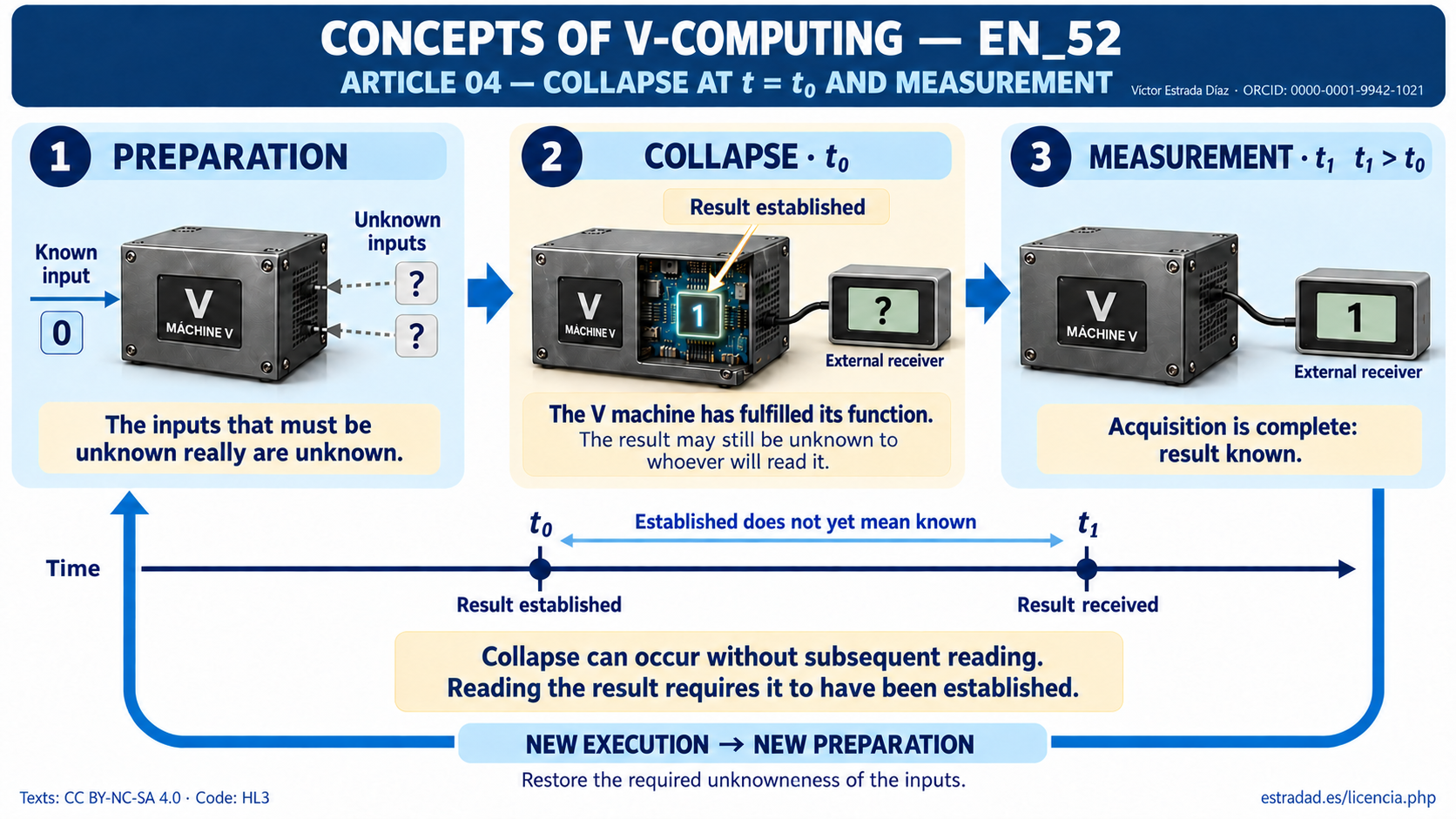
This article distinguishes preparation, collapse and measurement in an execution of the V machine.
Collapse establishes the execution’s result. Measurement allows it to be obtained and known.
The recipient of the result may be a person or another machine.
V execution begins with preparation.
The inputs that must be unknown must really be unknown to whoever will perform readout.
Lack of knowledge forms part of this V machine’s preparation conditions.
We denote the instant when collapse occurs by t₀.
In the definition of V used here, collapse establishes the execution’s result and resolves the uncertainties corresponding to that result.
Once collapse has occurred, the V machine has fulfilled its function in that execution.
The fact that the result has been established does not mean it is already known to whoever will read it.
At t₀ it may remain unknown to that person or machine.
Collapse does not require subsequent readout to take place.
Measurement encompasses the process needed to obtain the result. It does not require a person’s intervention: another machine may perform measurement and receive it.
We denote the instant when acquisition of the result is completed and it becomes known to its recipient by t₁.
If readout is completed after collapse:
t₁ > t₀
The result is established at t₀ and knowledge of it is completed at t₁.
Subsequent readout obtains that execution’s result; it does not retrospectively change what was established at collapse.
Collapse and measurement designate different aspects of the described process.
Collapse may occur without the result being read afterwards.
In this definition of V, obtaining an execution’s result through measurement requires that result to have been established by collapse.
For example, an experiment may be arranged in which collapse occurs at 2 o’clock and readout of the result is completed at 4 o’clock.
Between these times, the result is already established, even though its recipient still does not know it.
The V machine can be reused for a new execution.
To do so, it must go through all preparation phases again.
In particular, inputs that must be unknown must really be unknown in the new execution.
Reading the previous result again does not constitute a new V execution.
A readout that dispenses with the required preparation and collapse does not correspond to the V-machine process defined in this article.
To compare Q and V, we distinguish establishing a result from subsequently acquiring or consulting it.
In Q, a result can also be recorded and consulted later. In usual quantum terminology, the interaction producing that record already forms part of measurement.
The temporal distinction allows us to describe when the result is recorded and when another person or machine receives it. It does not, by itself, identify the physical mechanisms of Q and V.
Preparation establishes the conditions of a V execution, including the required unknownness of the inputs.
Collapse at t = t₀ establishes the result and completes the machine’s function in that execution.
Measurement allows that result to be obtained. Knowledge of it is completed at t₁, which may be later than t₀.
A new execution requires new preparation.
Previous articles:
EN_52_01 — To exist is not to be observed.
EN_52_02 — The box and Schrödinger’s cat.
EN_52_03 — The Qᵦ bit and the Qᵥ bit.
Next article:
EN_52_05 — The internal function f(t).
END OF ARTICLE 04