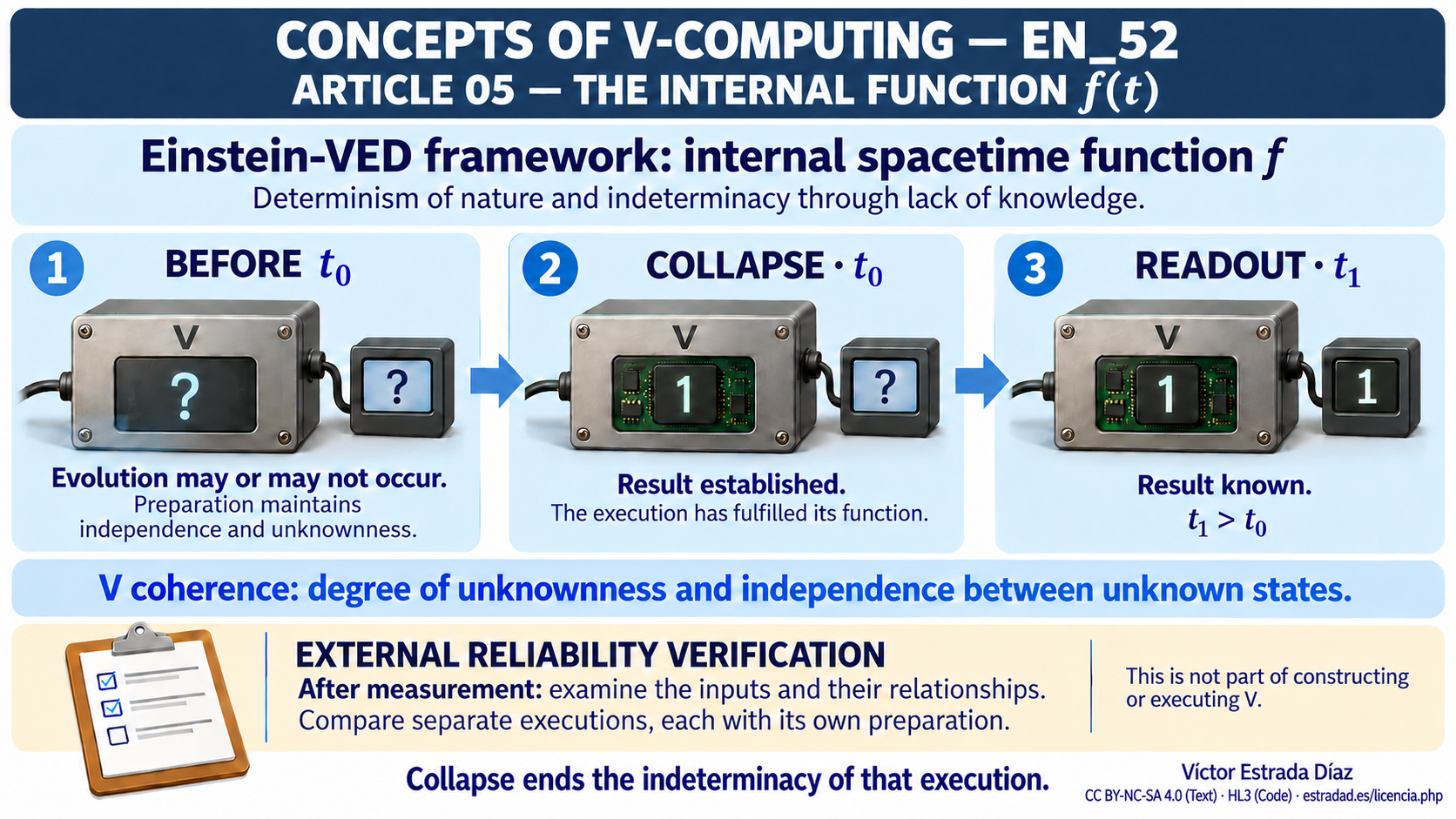
ARTICLE 05 — THE INTERNAL FUNCTION f(t)
Author: Víctor Estrada Díaz ORCID: 0000-0001-9942-1021 Project: ES_52 Series: Concepts of V-computing Status: Checked and closed by the author — 22 October 2026
Dual license — Ethics and use
Texts: CC BY-NC-SA 4.0. Sharing and adapting the texts is permitted with attribution to the author, without commercial use and with adaptations shared under the same license. https://creativecommons.org/licenses/by-nc-sa/4.0/
Code: HL3 — Hippocratic License 3.0. Commercial use of the code is permitted only if it complies with the ethical principles and the license conditions. https://firstdonoharm.dev/version/3/0/
Author’s ethical restrictions: uses for wars, human rights violations, environmental harm, exploitation, mass surveillance and discrimination are prohibited.
Author’s ethical principles: respect for human dignity, no profit-making use without permission and prohibition of harmful uses.
Reference for the dual license and the author’s conditions: https://estradad.es/licencia.php
Within the Einstein-VED framework, the author introduces a function f internal to spacetime to address the relation between nature’s determinism and the indeterminacy associated with lack of knowledge of its internal reality.
In this proposal, nature is deterministic, but indeterminacy exists through lack of knowledge of its internal reality. What is unknown does not cease to have reality because the machine does not know its state.
The function f internal to spacetime is the one the author introduces in Einstein-VED to relate that determinism to quantum indeterminacy. This is the premise of the framework from which V is built.
Knowing the construction, its purpose and its relations does not amount to knowing the internal state of a prepared execution.
The V machine can be built for a purpose and tested with fixed values. Once prepared for the execution considered, its internal state must remain unknown to the machine before t = t₀.
No particular form of internal evolution is required. What matters is maintaining independence and unknownness before t = t₀.
Preparation must ensure both conditions hold throughout that interval, not only at the initial moment.
Internal evolution may or may not occur. If an unknown state evolves in an unknown way and the required independence is maintained, it continues to satisfy the V condition.
If it converges to a state known or deducible by the machine before t₀, it ceases to satisfy that condition. Convergence alone does not violate it if the state remains unknown and independent.
In the author’s framework, V coherence expresses the degree to which what is not known is genuinely unknown and independent of the other unknown states.
Preparation must maintain that condition before t₀. Coherence can only be measured after collapse; no prior measurement is introduced that provides access to states that must remain unknown.
Checking coherence or decoherence is an external verification and reliability mechanism. It is not part of the V machine’s construction and does not add a phase to its execution.
Once measurement is completed, after t₀, the previously unknown inputs can be known and examined. Their degree of independence and their relations are then checked to assess whether the required conditions were maintained before collapse.
Separate executions may also be performed, each with its own preparation, and the resulting data compared to check whether the inputs that had to be unknown really were unknown and maintained the required independence.
This subsequent verification examines execution reliability. It does not give V advance knowledge of its inputs or intervene to determine its result.
At t₀, collapse establishes that execution’s result and the V machine has fulfilled its function.
Triggering collapse ends the indeterminacy of that execution’s result: what previously remained unresolved is fixed in a specific result.
This is the meaning of the end of indeterminism in V within the author’s framework. It does not mean that no internal state existed beforehand or that its evolution had to be known for the machine to operate.
Before t₀, preparation maintains the required independence and unknownness. At t₀, collapse resolves the result. Its acquisition may be completed afterwards.
The indeterminacy resolved by collapse must be distinguished from the lack of knowledge that the result’s recipient may still have. The machine has already fulfilled its function even if that result has not yet been communicated or read.
At t₁, acquisition of the result is completed. It may be the case that t₁ > t₀.
Once obtained, that execution’s result is known: it is not treated as a probability of what might have resulted.
Subsequent readout obtains the result established at t₀. It does not turn that result into the value the function might have at another instant.
Collapse may occur without subsequent readout. A new execution requires repeating preparation and again ensuring the required independence and unknownness before the new t₀.
V1 provides an already established example for the Deutsch problem: distinguishing constant and balanced binary functions.
The local report establishes, for the answer bit:
q₀ = fₒ(0) XOR fₒ(1)
Here fₒ denotes the Deutsch oracle function; it is not the time function f(t).
The answer is 0 for tables 00 and 11, and 1 for 01 and 10. All four cases agree with the protocol’s Q1 reference.
The local structural analysis gives a cost of O(1) per execution for this fixed-size circuit. That count does not measure latencies against a physical quantum computer.
The reference documentation for the V1/Q1 comparison and its time order is the ES_52 work in UNIHOLOG and DEMUESTRA/Proyectos/ES_52. Complexity order is distinguished from actual duration in seconds.
In DEMUESTRA, documentary verification will be performed exclusively on the Spanish .md files in Proyectos/ES_52. This reference identifies the documentation to be checked; it does not declare that a new verification of its results has been performed.
The internal function f belongs to the Einstein-VED framework from which V construction is proposed. The proposal distinguishes internal reality from knowledge of it.
For the V machine, internal evolution may or may not occur: the requirement before collapse is to maintain independence and unknownness. Their degree defines V coherence, which is measured only after collapse. Preparation must maintain these conditions before t₀. Collapse establishes the result and acquisition allows it to be known afterwards.
This is why triggering collapse ends the indeterminacy of that execution: the result is established at t₀, even if knowledge of it is completed at t₁. To set up another execution under V conditions, the machine must be prepared again.
Base project, section 9: ./../UNIHOLOG/ES_52_Maquina_V_UNIHOLOG.pdf Established V1 result for Deutsch: ./../UNIHOLOG/ES_52_Resultados_preparacion.pdf Demonstration: ./../DEMUESTRA/Proyectos/ES_52/ES_52_Maquina_V_UNIHOLOG.pdf Relations, measurement and Bell: ./../DEMUESTRA/Proyectos/ES_52/ES_52_Relaciones_medida_y_Bell.pdf
Scope of verification in DEMUESTRA: Spanish .md files only. Translations or other formats will not be used as substitutes for that review.
Local reports previously consulted in UNIHOLOG: ./datos/ES_52_EnsayoBellV1/resultado_asentado_v1.json ./datos/ES_52_EnsayoBellV1/analisis_complejidad_v1.json
RELATION TO THE SERIES
Previous: ./pdfs/EN_52_04_ConceptosVcomputacion.pdf
Next: ./pdfs/EN_52_06_ConceptosVcomputacion.pdf
END OF ARTICLE 05