ARTICLE 06 — RELATIONS AND SUPERPOSITION
Author: Víctor Estrada Díaz ORCID: 0000-0001-9942-1021 Project: ES_52 Series: Concepts of V-computing Status: Text checked and closed by the author — 22 October 2026
Dual license — Ethics and use
Texts: CC BY-NC-SA 4.0. Sharing and adapting the texts is permitted with attribution to the author, without commercial use and with adaptations shared under the same license. https://creativecommons.org/licenses/by-nc-sa/4.0/
Code: HL3 — Hippocratic License 3.0. Commercial use of the code is permitted only if it complies with the ethical principles and the license conditions. https://firstdonoharm.dev/version/3/0/
Author’s ethical restrictions: uses for wars, human rights violations, environmental harm, exploitation, mass surveillance and discrimination are prohibited.
Author’s ethical principles: respect for human dignity, no profit-making use without permission and prohibition of harmful uses.
Reference for the dual license and the author’s conditions: https://estradad.es/licencia.php
A relation may be known even though its values are unknown. This distinction allows a V machine to be built, its operations defined and a result obtained without prior knowledge of its internal states.
The objective is to build V and confront it with the same problems as its Q reference to compare results and times. There is no need to adopt an interpretation of Q’s internal reality to define V’s construction.
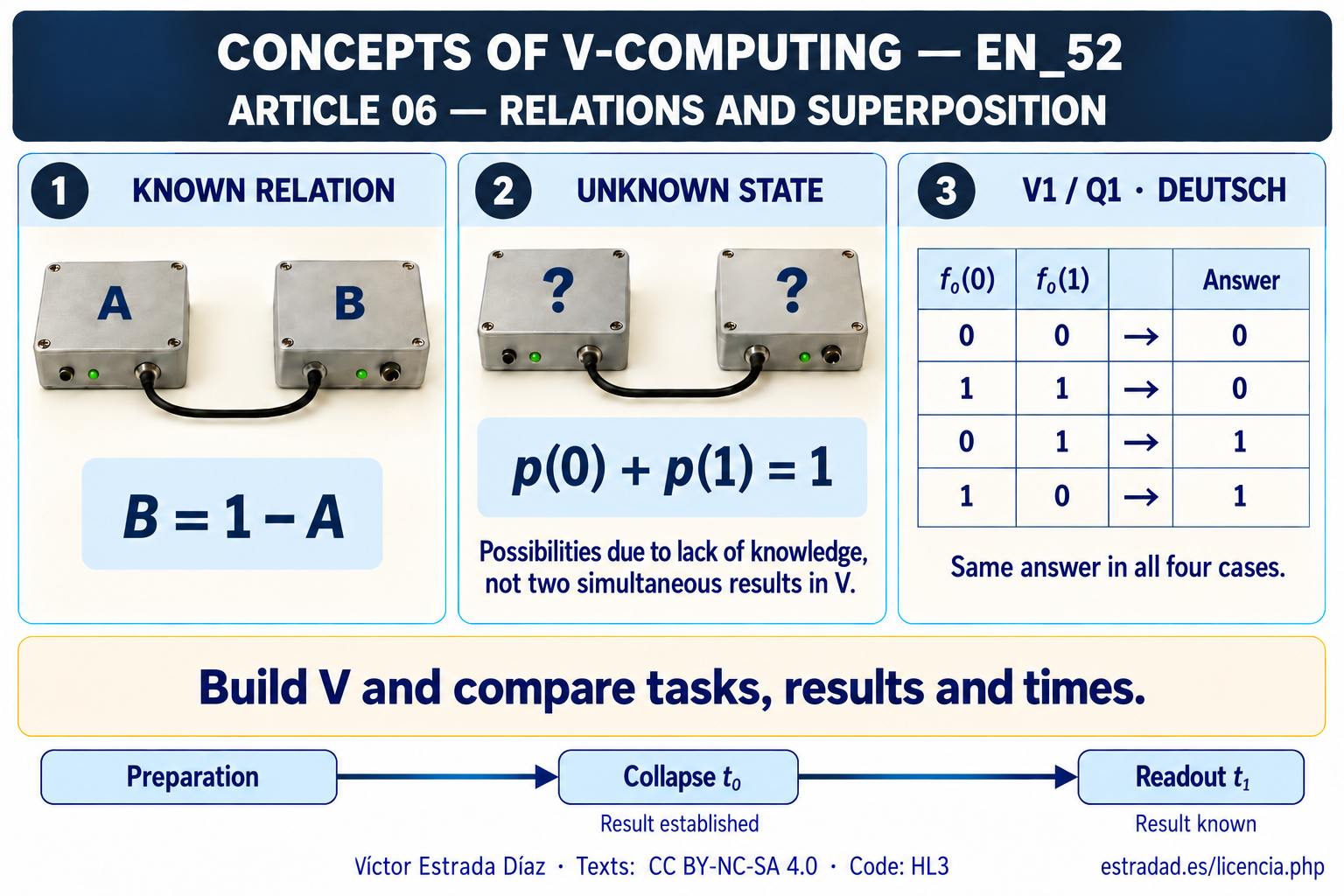
Consider two binary values A and B related by:
B = 1 − A
Knowing this relation allows us to state that the values are opposite without knowing which is 0 and which is 1.
The compatible possibilities are:
A = 0, B = 1
A = 1, B = 0
Listing those possibilities in an explanation does not imply that the machine must store or iterate through them in order to operate.
Preparing a relation does not require first reading its unknown inputs. Construction establishes connections and operations; values that must remain unknown are not obtained in advance to perform those operations.
Internal evolution may or may not occur. Preparation must maintain the required unknownness and independence before t₀, as explained in EN_52_05.
In V, preparation, collapse at t₀ and acquisition completed at t₁ retain the meaning given in article 04.
A new execution requires new preparation. Rereading an already established result does not replace that preparation.
In V, the unknown state is not defined as a superposition of the values 0 and 1.
The fact that both results are possible in the description of someone who does not know them does not mean that the V unit must contain both values simultaneously as execution results.
The degree of unknownness can be expressed through uncertainty or probabilities. For a valid binary output:
p(0) + p(1) = 1
This expression does not require the probabilities to be equal or replace the machine’s physical or computational relations.
Probabilities describe possibilities before the result is known. The result obtained in an execution is a specific value, not two superposed values.
The term superposition appears in the title to situate the topic within the series. It is not introduced as a requirement or an internal definition of V. The article does not seek to resolve interpretations of Q.
In the Deutsch task, V1 and the Q1 reference agree on the bit distinguishing constant and balanced functions.
Constant 0: table 00 → answer 0. Constant 1: table 11 → answer 0. Identity: table 01 → answer 1. Inverter: table 10 → answer 1.
The answer bit satisfies:
q₀ = fₒ(0) XOR fₒ(1)
fₒ is the Deutsch oracle function, distinct from the internal function f of the Einstein-VED framework.
The table above presents the inputs of the four checked cases and their answers; it does not describe an advance query of V1’s unknown internal states.
This agreement demonstrates a specific task solved by V1 with the same answer as Q1. The example supports the explanation of V relations; it does not replace the central topic with a discussion of Q’s internal nature.
The comparison starts with the same problem, the corresponding inputs and the result each machine must deliver.
In addition to checking answers, time is compared under a common criterion: which operations are included and whether the discussion concerns complexity order or measured duration.
The local V1 analysis establishes O(1) per execution for this fixed-size protocol. The ES_52 documentation in UNIHOLOG and DEMUESTRA/Proyectos/ES_52 is the reference for the scope of the V1/Q1 comparison. In DEMUESTRA, only Spanish .md files will be verified.
Equivalence concerns the tasks, results and costs actually compared. It does not require V to have the same internal structure or interpretation as Q.
Checking coherence or decoherence is external to V’s construction and execution, and is performed after measurement, according to EN_52_05.
Knowing a relation and knowing its values are different things.
V is built through known relations and states that remain unknown under preparation conditions. This lack of knowledge is expressed as uncertainty, without attributing superposition to it.
Collapse establishes a specific result; acquisition makes it possible to know it. V1/Q1 provides the verified Deutsch example. Comparisons aim to establish which problems each construction solves and at what time cost.
Relations between unknown values: ./../UNIHOLOG/ES_52_Maquina_V_UNIHOLOG.pdf ./datos/ES_52_EnsayoBellV1/resultado_asentado_v1.json ./datos/ES_52_EnsayoBellV1/analisis_complejidad_v1.json ./../UNIHOLOG/ES_52_Resultados_preparacion.pdf ./../DEMUESTRA/Proyectos/ES_52/ES_52_Maquina_V_UNIHOLOG.pdf
Documentary verification in DEMUESTRA: Spanish .md files only.
RELATION TO THE SERIES
Previous: ./pdfs/EN_52_05_ConceptosVcomputacion.pdf
Next: ./pdfs/EN_52_07_ConceptosVcomputacion.pdf
END OF ARTICLE 06