ARTICLE 07 — CORRELATIONS AND BELL
Author: Víctor Estrada Díaz ORCID: 0000-0001-9942-1021 Project: ES_52 Series: Concepts of V-computing Status: Draft for author review — unpublished
Dual license — Ethics and use
Texts: CC BY-NC-SA 4.0. Sharing and adapting the texts is permitted with attribution to the author, without commercial use and with adaptations shared under the same license. https://creativecommons.org/licenses/by-nc-sa/4.0/
Code: HL3 — Hippocratic License 3.0. Commercial use of the code is permitted only if it complies with the ethical principles and the license conditions. https://firstdonoharm.dev/version/3/0/
Author’s ethical restrictions: uses for wars, human rights violations, environmental harm, exploitation, mass surveillance and discrimination are prohibited.
Author’s ethical principles: respect for human dignity, no profit-making use without permission and prohibition of harmful uses.
Reference for the dual license and the author’s conditions: https://estradad.es/licencia.php
A correlation expresses a relation between results. This article distinguishes a correlation constructed through known relations from the specific conditions of a Bell test.
If two binary outputs satisfy:
B = 1 − A
their values are opposite. Not knowing A and B does not prevent knowledge of that relation.
On completing readout, the values obtained in that execution become known. The relation allows them to be interpreted, but does not, by itself, turn the device into a Bell experiment.
Comparing correlations requires identifying the inputs, operations and pairs of results belonging to each execution.
In the V process of this series, collapse establishes the result at t₀ and acquisition is completed at t₁. Each new execution repeats the required preparation.
No readouts of unknown internal values during preparation are added to explain correlations.
Bell inequalities limit the correlations of particular classes of models under explicit assumptions, including locality and independence of measurement choices from shared variables.
Quantum experiments have shown violations of these inequalities. Presenting two identical or opposite results is not enough to claim a violation.
If a V construction shares information between its parts or receives their settings jointly, that feature must be described when comparing it with Bell conditions.
A local computational selector trial with two V1 Python processes has been performed. Its results and limitations are presented in section 6. It is not a loophole-free physical Bell test.
The V1/Q1 verification for Deutsch establishes agreement of the answer bit for the four binary functions considered.
That result is an example of operational comparison. It is not, by itself, a Bell test or a demonstration of the correlations of a multi-unit machine.
The following trial uses only the installed V1, without modifying its construction. Later constructions remain reserved.
Two branches receive the same known oracle input. Each branch has two selection labels, 0 and 1, identifying interchangeable V1 copies, not different measurement operations.
Each trial prepares a new instance per branch. Each process receives only its local selector and the common input. The controller collects both results afterwards and calculates correlations externally.
8,192 paired trials were performed, equivalent to 16,384 V1 executions: 4,096 trials with ordered selection and another 4,096 with external random selection.
The q₀ bit, which answers the Deutsch problem, agreed between branches and with fₒ(0) XOR fₒ(1) in every execution and for all four oracles. The selectors do not generate V’s internal states or outputs.
For each selector pair, a product of +1 is assigned if the outputs agree and −1 if they differ. E₀₀, E₀₁, E₁₀ and E₁₁ are the averages of those products in each group.
The convention used is:
S = E₀₀ + E₀₁ + E₁₀ − E₁₁
For q₀, both selection modes gave:
E₀₀ = E₀₁ = E₁₀ = E₁₁ = 1
S = 2
Complete agreement in the Deutsch answer was therefore observed, but not a violation of the local Bell bound, |S| ≤ 2.
The two V1 machines on one computer passed the local checks performed: agreement of the Deutsch answer and compliance with the Bell inequality. No violation of that inequality was found in the trial data; q₀ gave S = 2. Passing these checks means satisfying those criteria, not exceeding the Bell bound or certifying a loophole-free physical test.
q₁ was also analyzed, without selecting the most favorable bit afterwards. It gave S = 1.998046875 with ordered selection and S = 2 with random selection.
The trial ran on a single computer with two Python processes. Neither Prolog nor a Spain–Italy setup was run, and physical isolation, independence of time references and absence of side channels were not certified. The controller knows both settings. Ordered selection is a control, not a test of setting independence.
In this trial, selectors are generated before the new instances are prepared; a physical choice following shared preparation is not certified. The records contain t₀ and software durations, not an independent measurement of t₁. There is no time comparison with Q hardware either.
The additional external check of the 16 possible local binary assignments gave a maximum |S| = 2 and a maximum 75% CHSH success rate with uniform settings. It is not part of V’s internal operation.
The result concerns the setup executed. It does not decide the behavior of all V constructions. Studying different measurement alternatives requires defining local operations, shared preparation and conditions of access to information.
Specific report with formulas, tables and relative links, PDF version: ./pdfs/EN_52_EnsayoBellV1.pdf
Results summary: ./datos/ES_52_EnsayoBellV1/resultados.json
Complete records: ./datos/ES_52_EnsayoBellV1/registros.jsonl
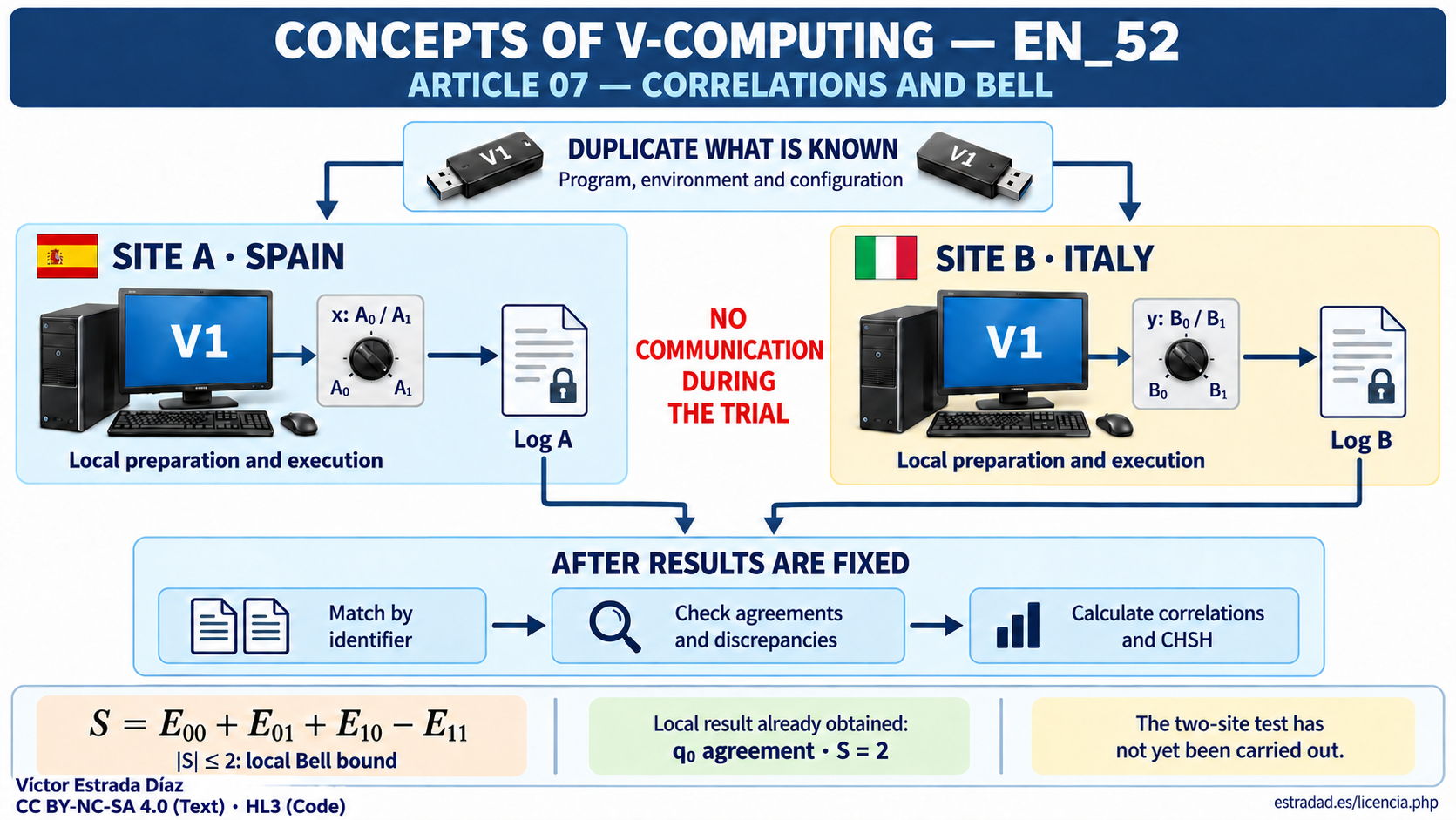
Verification can be extended to one site in Spain and another in Italy, by transporting a computer or installing a verifiable V1 copy there. The code, its environment and the known preparation are taken; not an execution in progress or already fixed unknown internal results.
In the USB variant proposed by the author, the program, environment and known configuration are duplicated before startup. Each site then starts its environment and prepares its own execution within the agreed window. A prepared execution in RAM is not copied. The branches share what is known, do not communicate during preparation or execution, and perform only the agreed tests without connections between them. Records are compared on completion.
Before starting, both sites agree on identifiers, oracles, trial count and incident handling. Each site prepares a new instance per trial and receives only its local selector. In the proposed random block, that selector is obtained externally after preparation and before triggering. Results are fixed and stored without consulting the remote selection or output.
Both bits, the oracle, selector, trigger, acquisition completion and incidents are recorded. After the records are closed, files are exchanged and their hashes verified. The analyzer pairs records by identifier, checks missing and duplicate records, checks the Deutsch answer and calculates the four correlations and CHSH. It does not select favorable pairs or hide failures.
The supplied local program does not yet implement autonomous branches between sites or all these time records. Local per-branch controllers and a subsequent comparator are needed. Running the current program twice, once in each country, is not equivalent to performing the distributed trial.
If equivalent copies continue to agree on q₀, the expected result is again S = 2. That would verify geographically distributed agreement, not a Bell violation.
A physical Bell test also requires justifying setting independence and the impossibility of communication during the trial through recorded positions, times and uncertainties. Distance or programming language alone does not guarantee them. These are conditions of external verification, not additions to V’s construction.
The superconducting Q reference used 30 meters in 2023. Photonic experiments at 1,203 km were published in 2017; they are not confused here with two general-purpose Q computers or identical loophole-closing conditions.
The detailed preparation, start, recording and comparison protocol is in section 9 of the report: ./pdfs/EN_52_EnsayoBellV1.pdf
This extension is proposed and has not been executed. The established results remain those of the local trial.
Each site will obtain and retain its own set of records. Once the agreed tests have been performed, both sets will be compared to evaluate correlations and compliance with test conditions. The distributed test’s result will be determined then, without declaring it passed or failed in advance.
Relating unknown values and checking correlations are different steps from demonstrating a Bell violation.
The local V1 trial preserves the Deutsch answer between selected copies and gives S = 2. This agreement is not a Bell violation. Evaluating another setup requires describing and checking its own conditions.
./pdfs/EN_52_EnsayoBellV1.pdf ./datos/ES_52_EnsayoBellV1/resultado_asentado_v1.json CHSH protocol: https://quantum.cloud.ibm.com/learning/en/courses/basics-of-quantum-information/entanglement-in-action/chsh-game Scientific background of the 2022 Nobel Prize in Physics: https://www.nobelprize.org/uploads/2026/05/advanced-physicsprize-2022-5.pdf Superconducting Q experiment, 30 meters: https://www.nature.com/articles/s41586-023-05885-0 Photonic experiment with stations separated by 1,203 km: https://arxiv.org/abs/1707.01339
RELATION TO THE SERIES
Previous: ./pdfs/EN_52_06_ConceptosVcomputacion.pdf
This stage of the exposition ends at article 07. The following constructions will be presented at a later stage.
The concepts are published from v-computacion, a project separate from UNIHOLOG. The ES_52 base project remains in UNIHOLOG. DEMUESTRA will work on the Spanish version of that base project; its documentary verification is limited to Spanish .md files.
THE BELL PROTOCOL AT TWO SITES WITH THE SAME V1 MACHINE
Sites A, in Spain, and B, in Italy, are designated. Before execution, the campaign identifier, trial count, known oracles, identifiers of each trial and handling of errors and missing records are agreed. It is decided to analyze q₀ as the Deutsch answer and q₁ separately as an additional output.
The V1 program, its modules, environment and known configuration are copied to two USB drives before startup. Versions and SHA-256 hashes are recorded. A prepared execution in RAM is not duplicated, and future results are not introduced. One copy remains at each site.
Each site starts its computer and locally checks the four known Deutsch cases. These installation runs are kept separate from the campaign to be analyzed. Each new execution requires its own preparation.
A start window and a public trial-identification plan are established in advance. Queries to the other site are removed from the test program and exchange channels are blocked during preparation and execution. A remote response is not used as a condition for producing the local output.
An agreed time does not demonstrate exact physical simultaneity. If Bell spacetime isolation is to be certified, positions, choices, results and clock uncertainties must be recorded, according to the specific report. A setup without these controls is presented as a geographically distributed computational check.
For the same identifier, both sites receive the corresponding known oracle and locally prepare a new V1. The unknownness and independence required by V’s definition are maintained. Preparation does not deliver the internal values that must remain unknown.
Each branch has two selection labels: A₀ or A₁ in Spain and B₀ or B₁ in Italy. In this repetition, they represent equivalent copies of the same V1, not different measurement operations.
An ordered control block may be performed first. In the random block, each external local selector obtains its bit after preparation and before triggering, without consulting the remote selector. Shared seeds or joint lists predetermining future choices in the random block are not distributed. How independence of settings from relevant internal variables is maintained is documented.
Each site triggers its V1’s collapse and records t₀. That execution’s result is established. Readout acquires that result and records its completion, t₁. A person need not observe during the process: the local controller records the data automatically.
The other computer is not consulted during this process. A consumed preparation is not repeated to replace an unfavorable result. If a trial fails, the incident is retained with its identifier.
For each trial, each site stores: campaign and trial identifier; known oracle; local selector; q₀ and q₁; acquisition status; choice instant; t₀; t₁; code version and hash; and incidents. Local clocks are distinguished from a common time reference and their uncertainty is noted where applicable.
The internal values needed for external coherence verification are examined only after collapse and measurement, following article 05’s procedure. Their independence is not considered certified merely because copies run in different countries.
Once the block’s results have been fixed, each file is closed and its hash calculated. The files can then be sent over a network or transported by USB to the external analyzer. This subsequent transfer does not participate in obtaining the outputs.
Hashes are checked and records paired by campaign and identifier. Duplicates, missing records, differing inputs and errors are detected. Pairs are not sought retrospectively to increase agreement, and failed trials are not hidden.
At each site separately, q₀ is checked to satisfy:
q₀ = fₒ(0) XOR fₒ(1)
Discrepancies between sites are counted for each oracle. This first check evaluates functional agreement and is reported separately from CHSH.
For q₀ and then q₁, records are grouped by selector pair: 00, 01, 10 and 11. Equal and different outputs are counted in each group:
Eₓᵧ = (number of equal outputs − number of different outputs) / Nₓᵧ
Each group is normalized by its own record count. If a setting pair is missing, CHSH cannot be estimated from those data. We calculate:
S = E₀₀ + E₀₁ + E₁₀ − E₁₁
The trial count per group, incidents, four correlations and S are reported for each bit. Only the most favorable bit is not selected afterwards.
The result is compared with the local Bell bound:
|S| ≤ 2
If outputs always agree in all four groups, all four correlations are 1 and S = 2. It is reported that no violation was observed in that sample. This finite observation is not turned into proof of absence of violation for every setup or future execution.
Statistical uncertainty and the conditions actually met are also evaluated. An estimate greater than 2 requires statistical analysis and auditing before it is attributed to a violation. An estimate less than or equal to 2 is described as observed non-violation, not as universal proof of locality.
If losses or failures occurred, correlations of only the successful cases are not assigned the scope of a loophole-free test. The agreed treatment is applied and, where necessary, that Bell interpretation is declared inconclusive.
The final report retains both original files, their hashes, the prior plan, versions, selection procedure, counts and analysis. It explicitly distinguishes V1 agreement, the observed CHSH value and the isolation and independence conditions verified.
In the trial already performed on a single computer, q₀ agreed completely and S = 2. No result is anticipated for Spain–Italy: it will be determined by executing and comparing records from both sites.
The distributed controller, choice after preparation and separate recording of t₁ remain to be implemented. The supplied program runs two branches on one computer; it must not be presented as an already available distributed executor.
The PDF articles and their reference files are available on the author’s website: https://estradad.es Consult mainly the V-COMPUTACION, UNIHOLOG and DEMUESTRA projects.
Direct web access to the developed protocol and its formulas, PDF version: https://estradad.es/teorias/pdf/V-COMPUTACION/pdfs/EN_52_EnsayoBellV1.pdf
Relative link to the same PDF within the project: ./pdfs/EN_52_EnsayoBellV1.pdf
END OF ARTICLE 07